There are cities you visit by following a map, an itinerary, and a succession of monuments. And then there are cities that demand more: you need to take the time to observe them, listen to them, and gradually learn how to read them.
Abomey belongs to this second category.
When you arrive in this former royal capital of Benin, nothing truly prepares you for the richness of the language hidden behind its walls, bas-reliefs, recades, appliqué textiles, objects of power, and stories passed down from generation to generation.
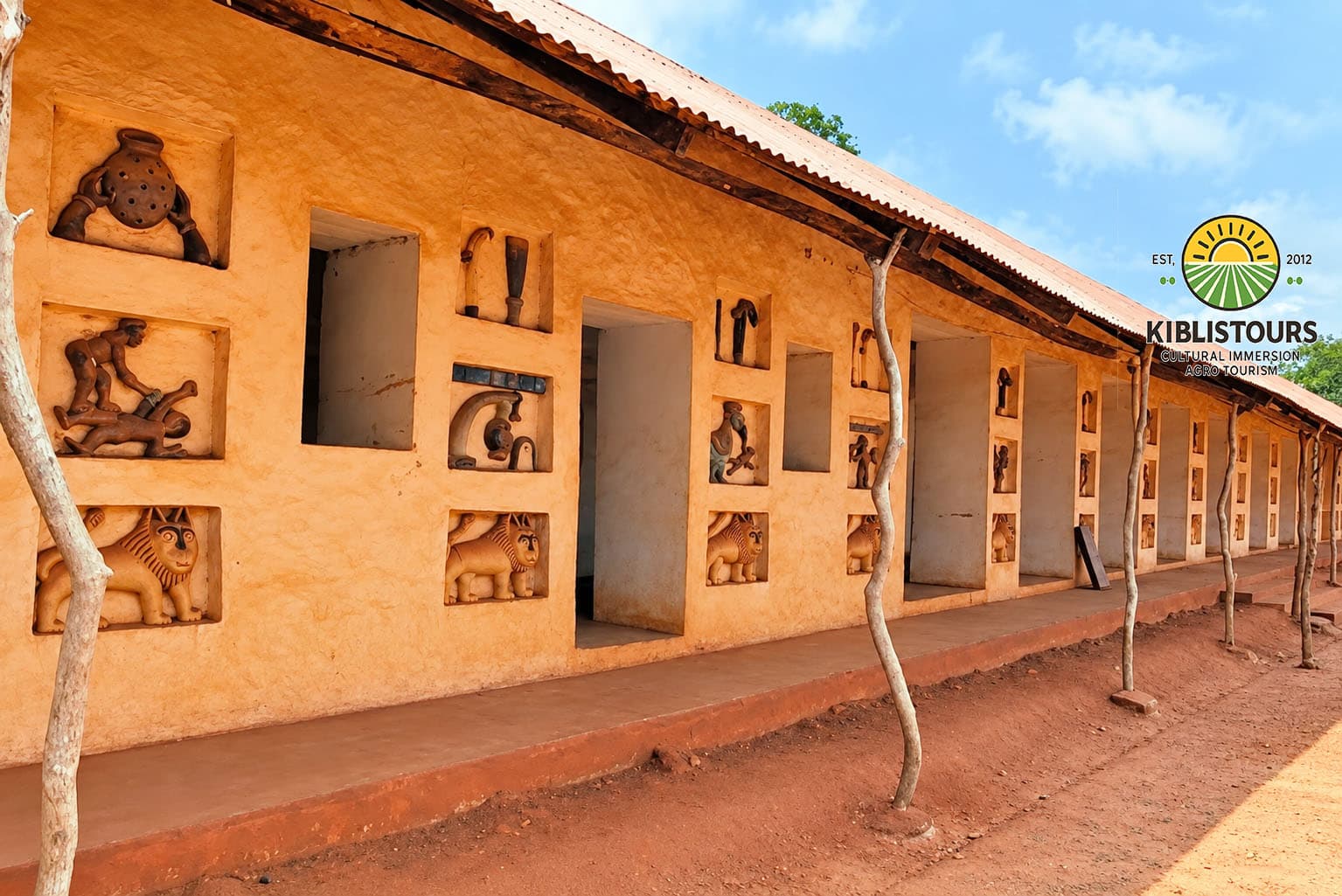
A lion, a shark, a buffalo, a bird, a pineapple, a perforated jar, or two hands protecting an egg: to someone discovering them without explanation, these images might seem merely decorative. Yet in Abomey, they are anything but insignificant.
They speak of power and conquest, but also of independence, resistance, solidarity, fragility, and memory.
For several centuries, the rulers of Danhomè more commonly known as the Kingdom of Dahomey in French-language historiography, were associated with emblems, mottos, and representations capable of expressing their identity, certain aspects of their reign, their conception of power, or the events that marked their era.
This is why a visit to Abomey can be very different depending on how you choose to experience it.
You can enter a palace, observe a few objects, take photographs, and leave. But you can also slow down, stop in front of a symbol, listen to its story, discover the ruler with whom it is associated, and understand the context in which it appeared.
At that moment, an image that seemed simple just a few minutes earlier becomes a gateway to several centuries of history.
This is precisely the way of travelling that Kiblistours wishes to introduce: an experience in which monuments are not merely visited but understood; where stories are not turned into folklore; and where traditions are approached with respect, curiosity, and nuance.
For the kings have long since left Abomey's political stage.
Their symbols, however, continue to tell their stories.
Abomey, a royal capital (Destination Benin: ABOMEY, the indomitable city of conquerors, or the “Roman Empire” of the Gulf of Guinea), discovered layer by layer.
Located in the Zou Department, in south-central Benin, Abomey was the political centre of the Kingdom of Danhomè for several centuries.
From one ruler to the next, the city was transformed. Palaces were built, courtyards laid out, and workshops developed to produce royal objects, textiles, sculptures, and insignia of power. Ceremonies were held there, and decisions concerning war, diplomacy, trade, administration, and religion were made there.
The palace was therefore not simply a ruler's residence. It embodied a political organisation and a particular conception of power.
Today, the Royal Palaces of Abomey (UNESCO, Royal Palaces of Abomey) on the UNESCO World Heritage List since 1985, constitute one of Benin's major heritage complexes.
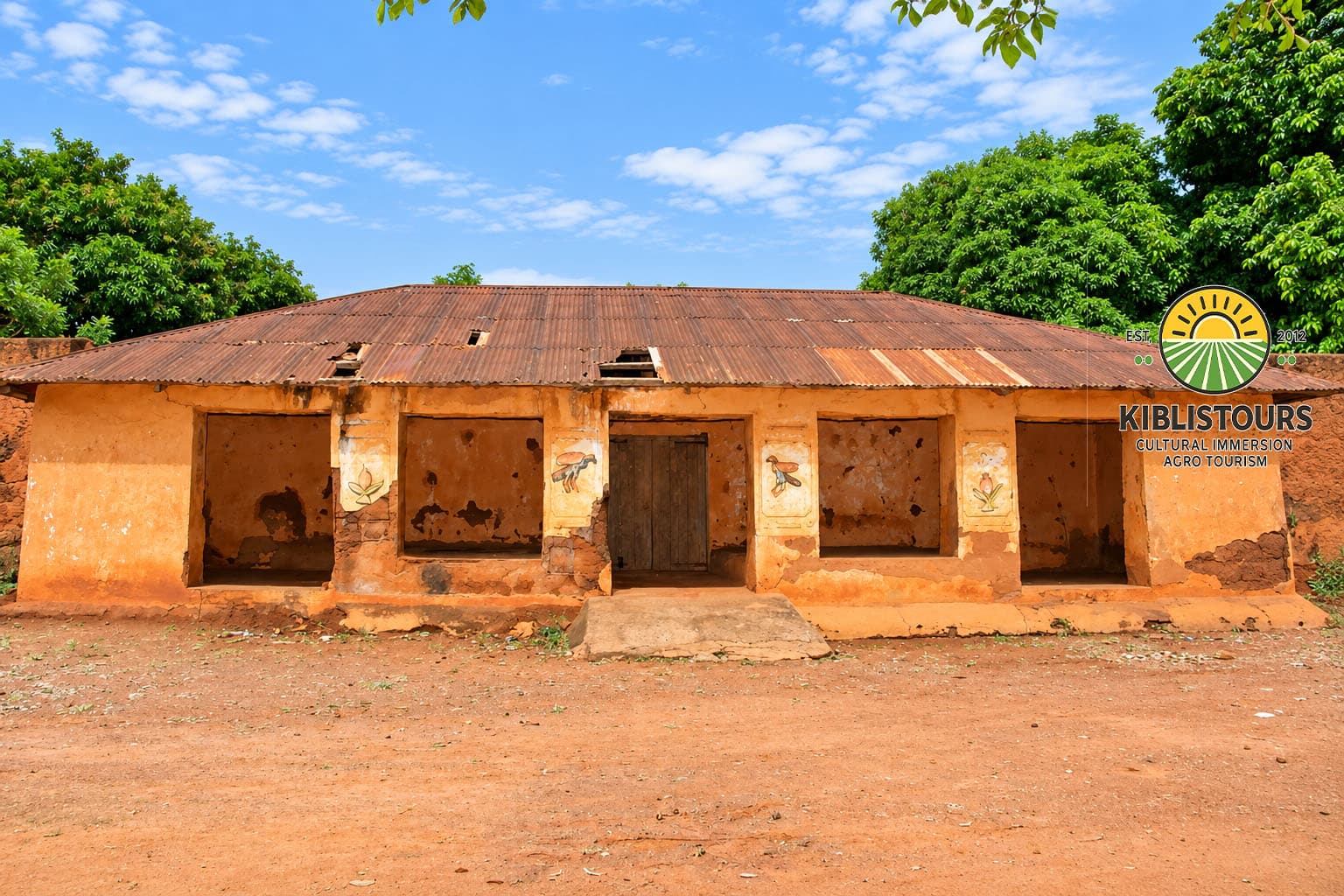
The complex still reveals traces left by several generations of rulers through the organisation of its spaces, architecture, objects, and symbolic representations.
A palace that tells the story of several reigns
One of Abomey's fascinating features is that the royal complex is not limited to the palace of a single ruler.
Each king placed his reign within the continuity of the dynasty while leaving his own mark. He built, transformed, or added new spaces, thereby marking his era.
The result is a heritage landscape that almost resembles a chronology transformed into architecture.
As you walk through these spaces, you are not simply moving from one courtyard to another: you are symbolically passing through several reigns. The walls cease to be mere remains and become witnesses to different eras, decisions, and rulers.
This is where symbols become essential.
They give a visual identity to the kings who succeeded one another over the centuries and gradually allow visitors to establish connections between an image, a ruler, and his history.
Why did the kings of Dahomey have symbols?
For a contemporary traveller, it may be tempting to compare these emblems to logos. The comparison helps explain their identifying function, but it remains far from sufficient.
Royal symbols belonged to a much deeper political and cultural universe. They could identify a ruler, recall a motto, express a metaphor, evoke an event, or convey a particular conception of authority.
In a society where speech, images, objects, ceremonies, and traditions played an important role in transmitting memory, a symbol could condense what a lengthy text might have explained elsewhere.
An image capable of replacing a portrait
It was not necessary to depict the king's face realistically for people to know who was being represented.
A lion could evoke Glèlè. A shark could recall Béhanzin. A representation of a buffalo could refer to certain rulers depending on the artwork and its context. Two hands delicately holding an egg pointed towards Agoli-Agbo.
The image thus became a form of political identity.
A motto transformed into an image
Royal emblems were not simply illustrations chosen for their beauty. They could be linked to a phrase, a motto, or a metaphor expressing how the ruler wished to present his authority.
The symbol therefore had several levels of interpretation: the animal or object was immediately visible, the motto had to be known, and the historical context made it possible to understand its full significance.
It is precisely this layering of meanings that makes discovering them so fascinating.
A memory that is easy to pass on
Imagine a child looking at the representation of a shark and asking:
"Why is there a shark here?"
To answer, an adult must talk about Béhanzin. One thing leads to another, and the themes of war, resistance, defeat, and exile emerge.
A simple image has just sparked an entire story.
A few decades later, that child, now an adult, will be able to pass this story on to a new generation.
This is how symbols become more than emblems: they become instruments of memory.
Before the kings: understanding the origins of the Abomey dynasty.
The kingdom's early history is based on historical research, dynastic traditions, and oral transmission.
The further back in time we go, the more important it becomes to accept that certain chronologies, genealogies, or interpretations may vary depending on the sources. This precaution does not diminish the value of history; on the contrary, it allows us to tell it with greater rigour.
An oral tradition is not a modern administrative archive. It transmits genealogies, founding episodes, conflicts, values, and memories through its own mechanisms.
Among the earliest figures associated with the Abomey dynasty are Gangnihessou, Dakodonou, and Houégbadja.
Gangnihessou: the opening pages of dynastic memory
Gangnihessou appears in several traditions as one of the earliest major figures of the royal lineage.
His exact position in the succession may, however, vary according to traditions and historical accounts. Rather than turning this complexity into artificial certainty, it is better to preserve and explain it.
For Abomey teaches us something essential from the very beginning:
History is also shaped by the way societies remember.
The representations associated with Gangnihessou already offer a glimpse of the role that symbolic language would gradually play in asserting the dynasty's identity.
Dakodonou: when a jar ceases to be an ordinary object
Dakodonou is also among the dynasty's earliest figures. Several traditions recount the circumstances of his political rise in the region.
Among the representations associated with him is a jar, linked to various stories passed down about his reign.
To an uninformed visitor, a jar may seem extremely ordinary. That is precisely what makes the symbol interesting: in Abomey, an everyday object can become the bearer of a dynastic memory several centuries old.
A simple rule for visiting Abomey
When you observe an object depicted on a bas-relief or artwork and do not understand why it is there, do not move on too quickly.
Take a few seconds to observe it and ask one simple question:
"What story lies behind this object?"
In Abomey, the answer may take you back several centuries.
Houégbadja: the builder who consolidated Abomey
Houégbadja holds a fundamental place in the kingdom's history. His reign, situated in the 17th century, is generally associated with the political consolidation of Abomey and the development of the palace system.
Among the images attributed to him is the combination of a fish and a fishing trap.
The metaphor evokes an idea of independence and determination: a fish that has escaped from a trap has no reason to return to it voluntarily.
Behind an apparently simple image, therefore, lies a way of telling the story of power.
Building a kingdom in the earth
Houégbadja is also an important figure in understanding the evolution of the palaces.
In Abomey, royal architecture is closely linked to the earth and the organisation of space. Walls, enclosures, courtyards, passageways, and ceremonial buildings all contributed to physically structuring power.
When visitors explore the remains of the Royal Palaces today, they are therefore not merely looking at ancient buildings.
They are observing the physical embodiment of a political system.
Akaba: power expressed through the wild boar
Akaba succeeded Houégbadja at the end of the 17th century. The wild boar is among the animals associated with his iconography.
The image has an immediate force: the animal advances, defends its territory, and may charge when it feels threatened. Its power is not the majestic, almost sovereign power that the contemporary imagination spontaneously associates with the lion. It seems more direct and physical.
Within the kingdom's political vocabulary, this choice helped construct a symbolic personality specific to the ruler.
No reign is ever exactly like the previous one
The royal spaces remind us that the dynasty was based on both continuity and individuality.
Each ruler inherited a kingdom shaped by his predecessors, but each also had to leave his own mark. The symbol contributed precisely to this distinction.
Agadja, the ship that opens history towards the Atlantic
Agadja's reign marked a major turning point.
In the 18th century, the kingdom extended its influence southwards, conquering Allada and then Ouidah. This expansion brought Danhomè directly into the trading networks of the Atlantic coast.
Among the emblems associated with Agadja is the ship.
This symbol opens one of the most complex chapters in the kingdom's history.
A ship means much more than trade
The ship evokes exchanges, goods, relations with Europeans, weapons, and negotiations. But it also refers to the transatlantic trade in enslaved people.
The Kingdom of Dahomey participated in this economy at different periods. People captured during wars or brought into other slave-trading networks were sold towards the coast, while Ouidah became one of the main departure points for the Atlantic slave trade in this part of Africa.
This dimension must be addressed accurately and without evasion.
Humanising history never means making it comfortable.
A heritage respected by also telling its difficult chapters
Dahomey was an important political and military power and developed artistic, administrative, and cultural traditions whose legacy remains visible.
But its history also includes conquests, wars, violence, and participation in the slave trade.
A credible tourism narrative must neither glorify this history nor reduce it to a simplistic condemnation. It must explain the facts, place them in context, and allow travellers to understand the complexity of the past.
Agadja's ship is precisely one of those symbols that demand such depth.
Tegbessou: the clothed buffalo and organised power
Tegbessou ruled in the 18th century. Among the motifs associated with him is a clothed buffalo.
To a traveller discovering this representation without explanation, it may seem strange. Why depict a buffalo wearing clothing?
This is precisely the kind of question Abomey invites us to ask.
The buffalo naturally evokes strength, while the clothing introduces a social, political, and human dimension. Raw power thus enters the world of organised authority.
The moment when visitors begin to read Abomey
As the visit progresses, certain motifs become familiar. You recognise them, compare them, and sometimes begin to anticipate the guide's explanation. A few keys are then enough for the heritage to cease being silent.
Kpengla: looking at what the symbol does
With Kpengla, certain animal representations depict a relationship of domination.
This teaches another important rule of interpretation: it is not always enough to identify the animal; you must also look at what it is doing.
Is it attacking? Grasping something? Resisting? Dominating an opponent?
The posture, movement, and relationship between the different elements of the representation may be an integral part of the message.
The royal symbol thus becomes a genuine miniature political scene.
Agonglo: the pineapple that surprises travellers
Among the royal emblems, Agonglo's often comes as a surprise: he is notably associated with the pineapple.
After powerful animals and scenes of warfare, this fruit may seem unexpected. Yet it helps us understand that Danhomè's symbolic vocabulary did not necessarily follow our modern categories.
Power could draw its language from animals as well as plants, objects, tools, gestures, or everyday situations.
Never impose your own interpretation
The pineapple ultimately teaches us an essential rule for discovering Abomey: do not decide in advance what a symbol must mean.
Observe first, then listen to the local explanation and ask which motto or story accompanies the representation.
This attitude applies to Abomey, but also to many African heritage traditions whose meanings have sometimes been simplified by outside perspectives.
Adandozan: the king who shows that memory is never neutral
Adandozan is one of the dynasty's most complex figures.
His reign, and especially the way his memory was transmitted after his deposition, raises a fascinating question:
Who tells the story of a ruler after his fall?
Adandozan was overthrown in the early 19th century. The political traditions developed under his successors contributed significantly to constructing a negative representation of his reign, while more recent historical research has encouraged a more nuanced interpretation of this memory.
A king can disappear twice
A ruler can disappear from power once and, in a sense, disappear a second time from the historical narrative.
When a new authority takes power, it may reorganise how the previous reign is recounted: certain stories become dominant, others fade away, some names are glorified while others are marginalised.
This complexity is valuable because it moves us away from a history composed solely of "good" and "bad" rulers.
The kingdom was a political space marked by rivalries, alliances, strategies, successions, internal conflicts, and economic interests.
Presenting Adandozan with nuance therefore makes the entire history of Abomey more credible.
Ghézo: the buffalo, power, and the story of the perforated jar
Ghézo is one of the kingdom's most famous rulers. He reigned in the 19th century, during a period of profound political, economic, and military transformations.
Several motifs are associated with his iconography, including the buffalo. But the image that probably leaves the strongest impression on visitors is that of the perforated jar.
A jar that no one can save alone
Imagine a jar with several holes.
Water is poured into it, but it immediately begins to escape. One person places a finger over an opening: it is not enough. A second person steps in, then a third, until every hole is plugged.
Only then can the water be preserved.
The metaphor is generally associated with the idea that the kingdom can only hold together if everyone makes a contribution. One person cannot plug all the holes.
A political image that became a universal lesson
This story is one of the best examples of the power of Abomey's symbolic language.
It belongs to a specific monarchical context, but its message remains immediately understandable today. Whether it concerns a family going through a crisis, a community protecting a common good, or a society facing a collective challenge, the same idea remains: no one can accomplish everything alone.
The perforated jar thus speaks of solidarity, responsibility, and collective effort.
A visitor may forget the exact date of a reign. They will find it much harder to forget the story of a perforated jar that several people must save together.
That is the full power of the symbol: transforming an abstract idea into an image, and then the image into memory.
Glèlè: the lion and the majestic assertion of power
Glèlè succeeded Ghézo in 1858. His reign took place during a period when European ambitions were intensifying along the coast and regional political balances were beginning to change profoundly.
His most famous emblem is the lion, an animal that spontaneously evokes power, majesty, and authority.
But in royal iconography, the symbol goes beyond this initial interpretation: it contributes to the political construction of the ruler's image.
Behind the lion, the artists
When admiring a royal symbol, we naturally think of the king. Yet another question deserves to be asked: who gave it its form?
Who carved the object, worked the metal, cut the fabric, or created the representations? Who knew the palace codes well enough to translate a motto into visual language?
The history of rulers is also the history of the artisans who gave physical form to their power.
This observation is important because Abomey still has craft traditions today that remind us how much artistic creation also contributes to the transmission of heritage.
Béhanzin: the shark that became a symbol of resistance
Béhanzin holds a special place in Beninese history and memory.
He ascended the throne at the end of the 19th century, as tensions with France intensified. His most famous emblem is the shark.
Why a shark for a king of Abomey?
This is exactly the kind of question a good visit should inspire.
Abomey is not located by the ocean. Why would a ruler based in this capital be represented by a marine predator?
Because the symbol does not seek to reproduce his geographical environment. It conveys a political metaphor: the shark expresses a power capable of defending its domain.
In the context of confrontation with France, this representation takes on a particular dimension.
The time of war
At the end of the 19th century, French colonial expansion led to a direct confrontation with the kingdom.
The Franco-DanhomeanWars gradually led to the defeat of Béhanzin's forces. The Agojié took part in the fighting, Abomey fell, and Béhanzin continued his resistance before surrendering in 1894.
He was subsequently deported, first to Martinique and then to Algeria, where he died in 1906.
Behind the hero, rediscovering the man
The risk with great historical figures is turning them into statues.
We speak of the king, the fighter, and the resistance leader, but much less often of the man.
Imagine for a moment someone who lived within Abomey's royal spaces, exercised supreme authority there, and then found himself thousands of kilometres from his territory, deprived of his kingdom and of the possibility of immediately returning home.
This human dimension does not erase the political figure. It simply allows us to better appreciate the violence of the historical rupture represented by exile.
Agoli-Agbo: two hands protecting an egg
After Béhanzin's defeat, the political context was profoundly transformed by French colonial domination.
Agoli-Agbo was placed on the throne in this new environment. His most famous emblem shows two hands holding an egg.
The image contrasts sharply with Glèlè's lion or Béhanzin's shark. It speaks not primarily of power, but of fragility.
Holding an egg requires control
Squeeze an egg too tightly and you break it. Hold it carelessly and you risk dropping it.
Protecting it therefore requires balance.
This is what gives the metaphor associated with Agoli-Agbo its full force. After generations of conquest, power, and resistance, the image now evokes a kingdom that must be handled with care.
A political ending that does not erase memory
The disappearance of the former independent kingdom does not mean the disappearance of all its memory.
Lineages, traditions, objects, and stories remain. Artists continue to create, and the symbols survive.
More than a century later, visitors still come to Abomey precisely to understand them.
The bas-reliefs of Abomey: when walls become archives
Bas-reliefs are among the most remarkable artistic expressions of royal heritage.
Animals, figures, weapons, and objects form scenes capable of evoking rulers, events, and mottos.
They constitute a genuine visual language.
Reading a wall without text
Imagine a book in which paragraphs have been replaced by animals, weapons, figures, and objects.
For those who know the codes, the story exists despite the absence of a lengthy written text.
That is why, when standing before Abomey's bas-reliefs, it is sometimes more appropriate to speak of reading rather than simply observing.
A visiting tip: start by observing
When standing before a bas-relief, take a few moments before taking a photograph. Identify the animals, positions, objects, and relationships between the figures, then compare your first impressions with the guide's explanations.
A photograph preserves the form. Understanding preserves the meaning.
Recades, sceptres, and insignia: when authority travels
Among the objects associated with royal power, recades occupy an important place.
They may be linked to the ruler's authority, the transmission of messages, or his symbolic representation.
The king does not need to be physically present for his power to be recognised: certain objects can accompany and embody his message.
Power sometimes fits in the hand
Today, we are familiar with official signatures, stamps, seals, and various insignia of authority.
In the Kingdom of Danhomè, certain objects also played a political role while constituting genuine works of art.
Politics and aesthetics were therefore not two separate worlds. They came together in objects of power.
Abomey's appliqué textiles: telling the stories of kings through fabric
Appliqué textiles offer another fascinating way of transmitting history.
Cut-out shapes are assembled on a textile background to create animals, figures, objects, and scenes.
A visitor unfamiliar with the codes may simply admire the shapes and colours. But someone who begins to recognise the symbols gradually sees something else: a lion reminds them of Glèlè, a shark of Béhanzin.
The fabric becomes a story.
Heritage also exists in the hands of people today
One of the most common mistakes is believing that Abomey's heritage belongs entirely to the past.
Artisans continue to work, families pass on techniques, and contemporary creators reuse or reinterpret certain motifs.
Heritage remains alive because there are still people capable of making, telling, and transmitting it.
Cyprien Tokoudagba: passing on the kings through art
This continuity takes on a particularly powerful human dimension through Cyprien Tokoudagba an artist from Abomey, a restorer of bas-reliefs, and a major interpreter of royal emblems. The Fondation Zinsou presents his work as a transmission of Dahomey's history, myths, and traditions: his paintings, inspired notably by the bas-reliefs of the Royal Palaces and the temples of Abomey, bring the rulers and a symbolic universe that continues to speak to contemporary generations back to life.
His career reminds us that royal symbols have not remained frozen in the past. They have continued to be painted, sculpted, restored, and reinterpreted. Abomey's memory therefore survives not only within its walls: it also survives through the gestures of artists.
Damien Tokoudagba: a family transmission of craftsmanship
This transmission also continues within families of artisans. Damien Tokoudagba, son of Cyprien Tokoudagba, has spoken about the heritage he received from his father in the art of bas-relief work. His journey gives a very concrete dimension to the idea of living heritage: behind the works admired by visitors are techniques, gestures, and knowledge learned, practised, and then passed on.
These voices replace neither historical research nor oral traditions. They simply show that, to understand Abomey, we must also look at the women and men who continue today to give shape to its memory.
An encounter can transform a memory
A handcrafted object takes on a different value when you have met the person who made it, observed their work, and understood the meaning of the motifs they use. This human dimension lies at the heart of the travel philosophy offered by Kiblistours.
The Agojié: moving beyond the myth of the "Amazones of Dahomey" (Ouidah origins)
The kingdom's famous female military units now occupy a considerable place in the international imagination.
Europeans long referred to them as the "Amazons of Dahomey." In the local context, they are notably known as the Agojié.
These women formed an important component of the military apparatus, particularly in the 19th century.
Cinema has sparked curiosity; history must go further
Contemporary cultural productions have enabled millions of people to learn of their existence.
This visibility creates curiosity, but it does not remove the need to return to history.
Who were these women really? How were they recruited and trained? What position did they occupy within the palace and the army? How has their memory changed over time?
These questions allow us to move from legend to history.
Real women behind the warrior image
Reducing the Agojié to their courage in battle would once again mean confining them to a character.
They were women living within a particular political system. Their history is therefore military, but also social, political, and human.
The 26 returned royal artworks: When history comes home to Benin (Restitution of 26 Artworks to the Republic of Benin)
Abomey's history did not end with the disappearance of the kingdom.
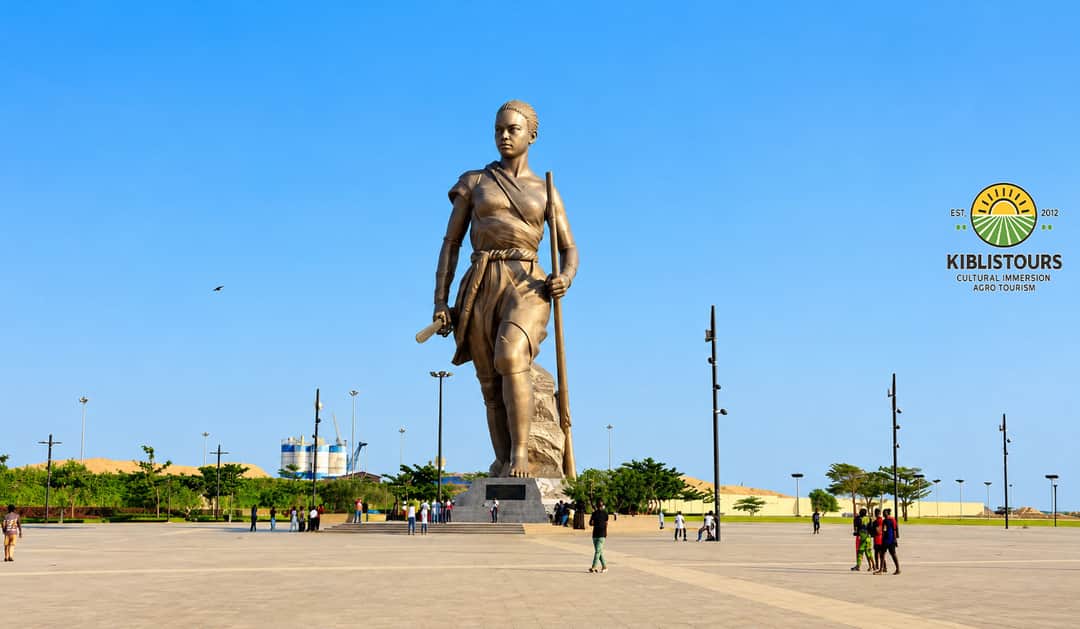
In 2021, France returned to Benin 26 works from Abomey's royal treasury, taken in the context of the colonial conquest at the end of the 19th century.
The return of these pieces goes far beyond their artistic value alone. It has also fuelled discussions about African heritage, colonisation, European collections, and the relationship between countries of origin and works essential to their own history.
A heritage object is never just an object
A heritage object can simultaneously carry memory, identity, loss, pride, pain, and continuity.
This is why heritage restitutions provoke debates and emotions that extend far beyond museum walls.
For Benin, the return of these of works physically brought back to its territory major elements of the history and representation of its former rulers.
Abomey and Ouidah: two cities to connect for a better understanding
To explore the kingdom's history in greater depth, combining Abomey and Ouidah in the same itinerary can be particularly relevant.
Abomey offers an insight into the kingdom's political centre. Ouidah opens onto the Atlantic, maritime trading networks, and the memory of the slave trade.
These two cities thus reveal different but closely interconnected dimensions of Benin's history.
Geography makes history tangible
On a map, Abomey, Allada, and Ouidah are merely names.
When travelling, distances become real. You cross territories, observe landscapes, and more easily understand political, military, and commercial movements.
This is one of the great advantages of historical travel: the territory gives a physical dimension to what books recount.
Another way to experience Abomey with Kiblistours
Now imagine your visit.
Standing before a representation, your guide might choose not to give you the answer immediately and simply ask:
"What do you see?"
You observe.
"A lion."
Then comes a second question:
"What does a lion evoke for you?"
You think of strength, royalty, and power. The name Glèlè comes next, and the image suddenly takes on another meaning.
A little later, you spot a shark. This time, you have already understood the principle.
"Béhanzin?"
At that precise moment, something has changed.
You are no longer simply listening to a tourist commentary: you are beginning to read the symbols yourself.
Contact us and book your appointment for a unique and unforgettable experience.
It is this participation that transforms a heritage visit into a genuine experience.
Abomey is not a tourist backdrop
It is important to always keep this reality in mind: Abomey is a living city.
Families live there, lineages preserve memories, cultural and spiritual practices remain important, artisans work, and descendants of royal families are still part of contemporary society.
Heritage is therefore not isolated from everyday life.
Photographing with respect
A magnificent traditional outfit does not turn the person wearing it into an automatically available photographic subject, any more than an everyday scene automatically becomes an attraction.
Asking permission before photographing someone remains a simple mark of respect.
Certain local rules must be followed
Restrictions may also apply to certain spaces, objects, or practices.
Following the instructions given on site and respecting the people accompanying the visit are integral parts of responsible exploration.
Avoiding superficial exoticism
African heritage has too often been presented as mysterious or spectacular without sufficient explanation.
In Abomey, the objective should be different: to understand, contextualise, and distinguish between documented history, oral tradition, and interpretation.
This is how heritage is truly respected.
How to prepare for your visit to Abomey
A good visit begins even before arrival.
Allow enough time
Abomey deserves a visit that is not rushed.
If you wish to understand the symbols, listen to the stories, and ask questions, allow sufficient flexibility in your itinerary.
Dress comfortably
As the climate can be hot, lightweight clothing, comfortable shoes, sun protection, and water will help make the visit more enjoyable.
Above all, bring your curiosity
You do not need to prepare a history lesson before arriving.
A few good questions are enough: why this animal? Why this object? Who made these works? What does this scene mean? Who still passes on this tradition today?
It is often these simple questions that open the most interesting conversations.
Visiting Abomey with Kiblistours: choose your level of immersion
A cultural visit becomes truly meaningful when it takes into account the time available, the desired level of immersion, and above all, what each traveller wishes to understand. Kiblistours can include Abomey in a dedicated excursion or a broader private cultural tour of Benin.
Standard Experience -The Essentials of Abomey
Indicative duration: one day. This package is suitable for travellers who wish to explore the main historical landmarks without rushing through the city. Depending on access conditions and the confirmed itinerary, the experience may include a contextualised exploration of the main accessible heritage sites, an introduction to the history of the Kingdom of Danhomè, explanations of the main royal emblems, and a guided interpretation of the bas-reliefs and objects visible during the visit.
Private transport can be arranged from Cotonou or another agreed departure point. Entrance fees, meals, and other included or excluded services are specified in the offer before booking.
Premium Experience -Understanding Abomey Beyond the Palaces
Indicative duration: one to two days. This package allows travellers to slow down further and explore in greater depth the connections between the rulers, their emblems, the kingdom's political history, artistic traditions, and the contemporary city.
Subject to local availability and authorisations, the programme may devote more time to bas-reliefs, recades, appliqué textiles, craftsmanship, and, where possible, an encounter with local heritage practitioners. Private transport, the organisation of stops, and any catering services are detailed in the proposal sent to the traveller.
VIP Experience -Abomey Through Private and Personalised Immersion
Indicative duration: two days or inclusion in a multi-day private tour. This package is intended for travellers who wish to make Abomey one of the highlights of their stay in Benin.
The experience can be designed around specific interests: monarchy and royal symbols, the Agojié, military history, artistic heritage, memory, craftsmanship, traditions, or connections between Abomey and the diaspora. Depending on local possibilities, it may combine in-depth heritage visits, private guidance, opportunities for discussion with artisans or heritage practitioners, and extensions to other historical territories.
Abomey can notably be connected with Ouidah to place the kingdom's political centre in perspective with the Atlantic coast and the memory of the slave trade, or be included in an itinerary featuring Cotonou, Porto-Novo, and other cultural destinations in Benin.
A private experience rather than a fixed programme
The durations and contents indicated are deliberately approximate. Certain spaces, encounters, or activities depend on opening hours, authorisations, availability, and local conditions. Before booking, Kiblistours specifies the selected itinerary, transport arrangements, entrance fees, any included meals, schedules, places to be visited, and services included and excluded.
The objective is not to multiply the stops, but to create the level of exploration that truly suits your journey.
What Kiblistours truly wishes to convey
Our vision is based on a simple idea: a place becomes more memorable when we understand the stories and people that give it meaning.
In Abomey, this means connecting the king to his symbol, the symbol to its motto, the reign to the territory, and the territory to the women and men who still pass on this heritage. If, several months after your stay, you still know why Béhanzin is associated with the shark or why several hands must save a perforated jar, your journey will have given you much more than a collection of images: a memory.
FAQ: the symbols of the kings of Dahomey and visiting Abomey
Where is Abomey located?
Abomey is located in the Zou Department of Benin. It is accessible by road from Cotonou and can be visited as a dedicated excursion or as part of a broader cultural tour.
Why is Abomey important in Benin's history?
Abomey was the political centre of the Kingdom of Dahomey for several centuries. Its palaces, artistic traditions, royal objects, and symbolic heritage are now major elements of Beninese history.
Are the Royal Palaces of Abomey UNESCO-listed?
Yes. The Royals Palaces of Abomey have been inscribed on the UNESCO World Heritage List since 1985.
Why did the kings of Dahomey have symbols?
The emblems served, among other purposes, to identify rulers, represent certain mottos, and visually convey ideas related to their authority, political identity, or reign.
What is Béhanzin's symbol?
The shark is the most famous emblem associated with Béhanzin. Today, it is strongly linked to the memory of his resistance against the French colonial conquest.
What is Glèlè's symbol?
The lion is one of the main emblems associated with King Glèlè.
What is Ghézo's symbol?
Ghézo's iconography includes several motifs depending on the artworks and traditions. The buffalo is notably associated with his representation. The famous perforated jar is also closely linked to the idea of unity and collective action during his reign.
What does the perforated jar mean?
The metaphor depicts a jar with several openings. One person cannot plug them all: several hands must work together to prevent the water from escaping. It thus expresses unity, responsibility, and collective effort.
Which king is associated with two hands holding an egg?
This emblem is associated with Agoli-Agbo. It is generally interpreted as a representation of the kingdom's fragility, which must be protected as carefully as an egg.
Why are Abomey's bas-reliefs so important?
They function as a visual language and can represent rulers, events, emblems, and various scenes related to royal history and ideology.
Who were the Agojié?
The Agojié were female military units of the Kingdom of Dahomey, particularly important in the 19th century. They were widely referred to in European sources as the "Amazons of Dahomey."
Have the 26 royal artworks returned to Benin?
Yes. In 2021, France returned to Benin a collection of 26 works from Abomey's royal treasury, taken in the context of the colonial conquest.
How much time should you allow for Abomey?
The duration depends on the depth of exploration you are looking for. For a genuine cultural experience, it is better to allow enough time to visit without rushing, observe the artworks, and listen to the explanations.
Can you visit Abomey with children?
Yes, naturally adapting the content to their age. Animal emblems can also provide an excellent introduction to history through a recognition game.
Can you combine Abomey and Ouidah?
Yes. This combination is particularly interesting: Abomey offers insight into the kingdom's political centre, while Ouidah allows visitors to explore its connections with the Atlantic and the history of the slave trade.
Should you visit Abomey with a guide?
Knowledgeable guidance provides real added value. Many symbols, objects, and representations take on their full meaning when placed in their historical and cultural context.
Can you take photographs everywhere?
Not necessarily. Restrictions may apply depending on the spaces, objects, or circumstances. Local instructions must always be respected, and it is recommended to ask permission before photographing someone.
Does Kiblistours organise private tours of Abomey?
Depending on available offers, the desired programme, and local conditions at the time of travel, Kiblistours can include Abomey in a private experience or a personalised cultural tour of Benin.
You can leave Abomey having photographed a historic site. Or you can leave knowing why the shark evokes Béhanzin, why the lion recalls Glèlè, and why a perforated jar still tells a story of solidarity.
It is this second experience that Kiblistours wishes to create with you.
Whether you are travelling alone, as a couple, with family, friends, or in a group, your experience can be devoted entirely to Abomey or included in a private cultural tour connecting Cotonou, Ouidah, Abomey, Porto-Novo, and other destinations in Benin.
Let's create your Abomey experience
To receive a personalised proposal, simply indicate:
- Your travel dates;
- The number of travellers;
- The time you have available;
- Your departure location;
- The other destinations you wish to explore;
- Your interests: royal history, symbols, Agojié, heritage, memory, craftsmanship, or a general exploration of Benin;
- Your preferred experience level: Standard, Premium, or VIP.
Kiblistours can then create an itinerary suited to your pace, expectations, and desired level of immersion.
Don't come just to see Abomey. Come to learn how to read it.
Kiblistours-"Experience Authentic Africa".
Book your spot now here.