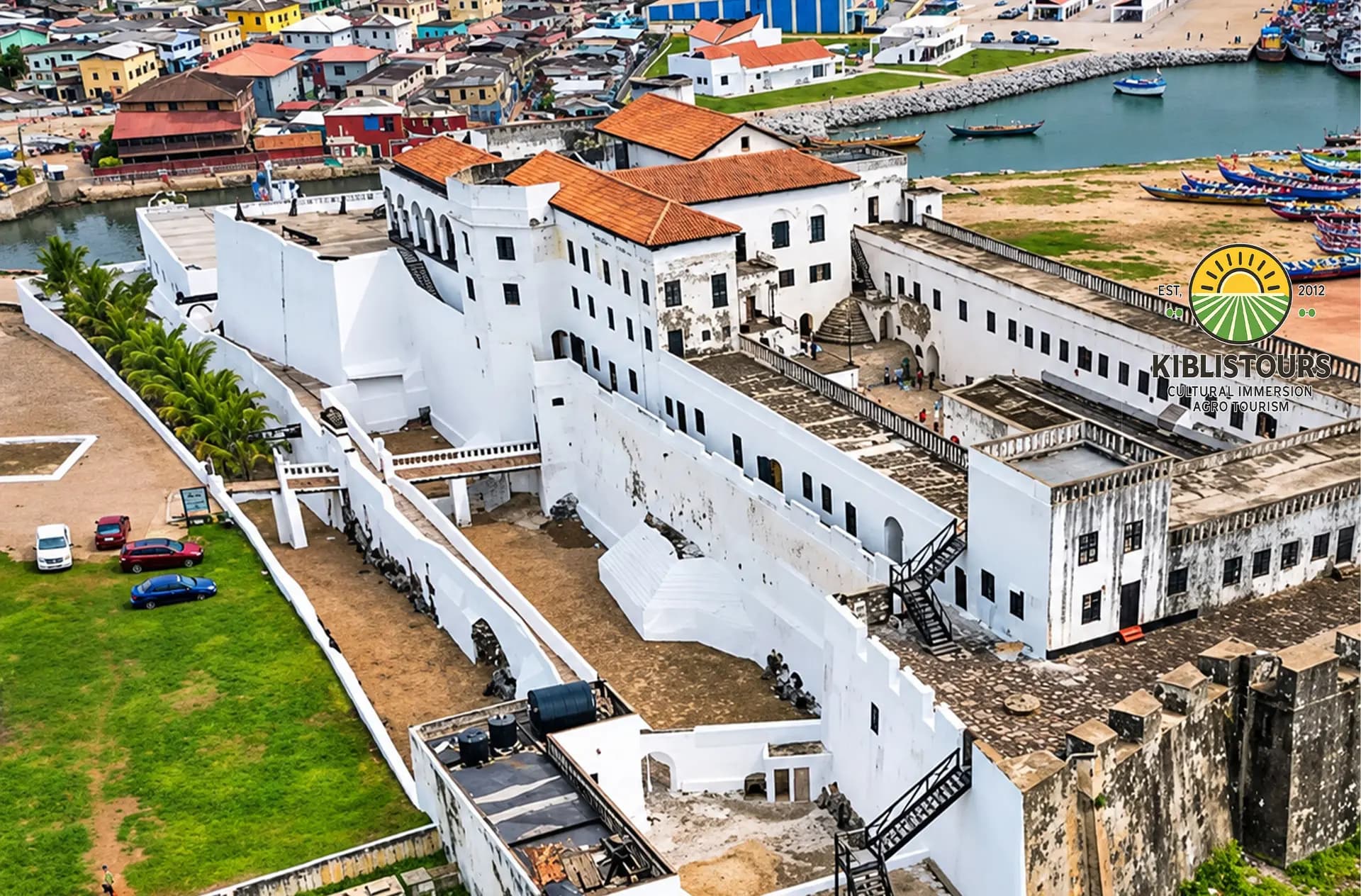
On Ghana’s coast, Elmina Castle stands prominently facing the ocean. The contrast between the fortress, the fishing harbour and the present-day town invites visitors to look beyond the façades: built in 1482 for trade, the castle later became associated with the transatlantic slave trade and the captivity of people forcibly transported to the Americas. This history cannot be approached as a sensational attraction; it calls for well-established facts, nuance and respect for the victims. With Kiblistours, the aim of exploring Elmina is to combine historical understanding, thoughtful organisation and consideration for today’s community, without claiming to replace local guides’ knowledge or inventing first-hand experience.
Elmina: Ocean, Town and Fortress
A strategic location between the Atlantic and the hinterland
Elmina’s location largely explains the castle’s historical importance. On the coast of present-day Ghana, near Cape Coast, the town stands at the meeting point of a maritime environment connected to Atlantic trade and inland territories with which economic and political networks existed long before the Portuguese arrived.
Building a fortress here was more than an aesthetic choice: it reflected a desire to secure trading operations, control access routes and consolidate a foreign presence in a region where African authorities and communities themselves played essential roles.
Remembering this reality helps avoid telling the coast’s history as though it began with the construction of European buildings. Coastal societies had their own institutions, diplomatic relationships, productive activities and knowledge of the territory.
The castle became part of this complex environment, sometimes through negotiation, sometimes through coercion and violence. Today, its commanding position still conveys the importance of monitoring the shore and the movement of ships.
The views of the ocean and surrounding neighbourhoods offer more than attractive panoramas; they invite reflection on why a military and commercial structure was built in this particular place.
For curious visitors, understanding Elmina’s geography therefore provides an initial key to interpreting the site: the sea evokes trading routes, the harbour recalls the continuity of local activities, and the castle walls bear witness to an era when rivalries between powers directly shaped the organisation of coastal spaces.
From São Jorge da Mina to a Major Site of Atlantic Remembrance
1482: The Portuguese foundation and the gold trade
UNESCO documentation dates the construction of St George’s Castle to 1482, at the beginning of a network of fortified trading posts that would later extend along part of Ghana’s coast. This date is essential, but it should not overshadow the earlier history of coastal societies: the Portuguese arrived within pre-existing African trading networks and political systems. The castle was initially associated with the gold trade and the protection of Portuguese commercial interests, before its functions changed. For visitors, this chronology explains why today’s walls tell the story of more than one era: they bear traces of successive alterations and changes of authority.
From Atlantic trade to forced transportation
Elmina Castle’s development into a major site of the transatlantic slave trade is one of the most painful aspects of its history. The trade was neither an isolated episode nor a process that operated identically in every port: it developed within a complex system of capture, sale, transportation and exploitation whose mechanisms varied across periods and regions.
At Elmina Castle, African people deprived of their freedom were held before being shipped to the Americas, where many were subjected to slavery and forced labour. Speaking about these men, women and children requires particular care with language.
They were not inherently commodities, but human beings turned into objects of transaction by a system founded on violence and dehumanisation. Historical accounts must also acknowledge the range of actors and responsibilities without obscuring the fundamental responsibility of the commercial, political and colonial structures that organised and profited from the trade.
A well-informed guided visit makes it possible to address these questions with nuance, distinguishing documented facts, interpretations and memories passed down over time. For visitors, the priority is not to collect shocking images or dramatic figures, but to understand the human and social consequences of a system that disrupted entire communities on both sides of the Atlantic.
The castle thus becomes a setting for historical education, raising questions about freedom, human rights, the legacies of violence and the responsibilities involved in passing on knowledge.
It is essential to distinguish the castle’s construction date from the longer chronology of the transatlantic slave trade. The building’s functions and the relative importance of different trading activities evolved. A rigorous heritage visit should therefore avoid indiscriminately attributing uses documented in later periods to the year 1482.
This chronological distinction may seem technical, but it fundamentally changes our understanding of the site: it shows how trading arrangements changed, how power relations hardened, and how the confinement of people became part of an Atlantic system of forced transportation and exploitation.
It also helps place the monument within a history in which individuals are not abstract categories, but distinct human lives.
1637: A change of control and Dutch interests
The Dutch capture of the castle in 1637 marks a new stage in its history and reminds us that the West African coast was also an arena of competition between European powers. Control of a fortress such as Elmina offered strategic, commercial and symbolic advantages, enabling maritime networks to be consolidated and economic interests on the coast to be defended.
This transition did not erase local dynamics or relationships with African societies; rather, it changed the conditions under which those relationships continued. Under Dutch control, the castle remained associated with Atlantic commerce, including the trade in enslaved people.
Alterations to certain spaces reflect the successive needs of its occupants, explaining why the present building is the product of several periods rather than the intact expression of a single historical moment. To understand the site, it is therefore better to avoid treating its walls and rooms as unchanging: the same part of the building may have served different functions at different times.
This observation highlights the value of explanations from heritage professionals, who can clarify what is known about a feature, an alteration or a particular use. The Dutch period also demonstrates how closely the monuments of Ghana’s coast are connected to global economic history.
Decisions made in European ports, the interests of trading companies and changes in Atlantic markets directly affected African lives. Visiting Elmina therefore reveals more than an episode in Ghana’s national history; it introduces an interconnected history whose effects crossed continents and generations.
Architectural changes undertaken under Dutch administration in the eighteenth century help explain why the spaces visible today do not correspond entirely to the original Portuguese castle. Heritage institutions refer, in particular, to substantial rebuilding during the 1770s.
This detail deserves attention during a visit because it reminds us that an ancient monument is not a frozen picture of the past. Successive alterations responded to military, administrative or residential needs, and some interpretations require support from plans, archives or specialist research. Visitors gain a more precise understanding when they learn to recognise these overlapping periods.
1872 and the castle’s changing uses
The transfer of the castle to British control in 1872 opened another phase, during which the building’s functions gradually evolved. The coast’s fortified buildings did not all follow the same trajectory, and uses documented elsewhere should not automatically be attributed to Elmina.
What can be retained is that the castle passed through several regimes and administrative contexts while its historical meaning changed. From a commercial fortress, it became a heritage monument and a place of remembrance whose conservation now entails public responsibilities.
The site’s value lies not only in its age or the durability of its walls, but also in its ability to bear witness to the complex relationships between trade, conquest, slavery and colonial administration. Today’s visitor encounters a place where different layers of the past overlap, sometimes without being immediately visible.
Restoration, adaptation and museum interpretation help make these layers legible, while also inviting questions about how the site is presented. What is shown first? Which narratives are emphasised? Which voices remain less audible? These questions do not diminish the visit’s value; they enrich it by making heritage a subject for reflection rather than an unchanging backdrop.
For Kiblistours, the challenge is to encourage this gradual understanding without turning painful episodes into attractions or presenting unverified claims as certainties. The quality of a historical visit depends as much on accurate information as on the ability to guide visitors through the complexity of the past.
UNESCO-recognised heritage
The 1979 inscription covers the collective property “Forts and Castles, Volta, Greater Accra, Central and Western Regions”, rather than Elmina Castle alone. The property includes three castles and several forts, among them St Jago. UNESCO highlights their importance to the history of the gold trade, the transatlantic slave trade and relationships between African and European societies. This recognition also carries a conservation responsibility: the site and its related monuments remain exposed to environmental pressures, maintenance needs and management challenges.
Inside Elmina Castle: Places, Uses and Silences
Entering the castle: Architecture as a historical narrative
Exploring Elmina Castle often begins with a powerful visual impression: thick walls, geometric forms, passages linking open and enclosed spaces, and sudden views of the sea. The architecture sets the pace of movement and gradually reveals the variety of functions once brought together within the building.
It would be misleading, however, to assume that the apparent beauty of certain areas tells the whole story. The same architectural complex protected commercial interests, housed authorities, accommodated religious activities and confined people deprived of freedom. This juxtaposition is precisely what makes the visit so instructive.
A courtyard may appear bright and welcoming, while a neighbouring room recalls extreme conditions of captivity; a window opening onto the Atlantic may evoke both trading routes and forced departures. The guide’s role is to explain these contrasts without resorting to easy dramatisation or diminishing the violence of the facts. How visitors move through the site also matters.
Taking time to observe thresholds, staircases, changes in level and circulation routes helps explain how power was expressed through space. For travellers, this attention turns the visit into a close reading of the monument: every visible feature becomes a possible question about past uses, the people who occupied the castle and the hierarchies imposed there.
An attentive visit therefore involves more than ticking off a succession of rooms; it connects material details with the human history they help us approach.
The dungeons: Understanding without making suffering a spectacle
Elmina Castle’s former dungeons are among the spaces that affect visitors most deeply. Their enclosed character, dim light and association with captivity invite a silence that each person may experience differently. These rooms should never be presented as a sensational setting intended to provoke an immediate response.
They recall detention conditions imposed on people stripped of their freedom and subjected to systemic violence. The visit should explain what is known about these uses while avoiding assigning a specific function to every architectural detail without sufficient evidence.
At places of remembrance, some stories endure because they capture the imagination; responsible interpretation nevertheless distinguishes testimony, interpretive traditions and firmly documented evidence. This requirement does not diminish the gravity of events. Instead, it ensures that remembrance rests on a foundation of knowledge that can be shared with future generations.
Visitors from different countries may feel sadness, anger, bewilderment or simply a need to reflect. None of these responses should be imposed or ranked. The support offered by Kiblistours should preserve this freedom of reaction and allow time for discussion after the visit when desired.
Remembrance tourism then becomes a practice of listening and education, in which the victims’ dignity remains central and emotion never replaces historical understanding.
The Door of No Return and the memory of departure
The Door of No Return holds a central symbolic place in a visit to Elmina Castle. Associated with the forced embarkation of people transported across the Atlantic, it concentrates the ideas of rupture, separation and imposed exile within a small space. Visitors should understand that the power of this symbol does not depend on dramatic staging.
It comes from the connection between a tangible place and the lives of people, many of whom were never able to return to their homeland. The passage towards the sea can thus become a point of reflection on dispersed families, broken ties and cultural legacies transformed by the history of slavery.
For people of African diaspora heritage, this stage may resonate with a personal or family search, but it would be inappropriate to assume that everyone experiences the place in the same way. Some come to honour ancestors, others to learn more about a shared history, and others to ask questions that no monument can fully resolve.
A respectful visit allows room for these varied motivations. It also recalls that the memory of forced displacement is not confined to a door or a castle: it survives in archives, languages, cultural practices and family histories across many territories. Elmina provides a powerful entry point into this transatlantic history, rather than an exhaustive summary of it.
Visitors leaving this space can continue reflecting beyond the walls, considering how contemporary societies acknowledge, teach and pass on the consequences of the trade.
Spaces of power and the fortress’s contradictions
The interior route reveals a major contradiction: spaces for command, commerce and religious practice coexisted with places of captivity. Officials’ apartments, courtyards and service rooms belonged to an organisation of power that cannot be understood without recalling the violence of the slave trade.
Comparing these areas helps visitors grasp concrete inequalities without exaggerating details whose historical function remains uncertain. The castle museum, described by the Ghana Museums and Monuments Board, holds gold weights, shackles, textiles, ceramics, photographs and other objects connected to local history.
These collections usefully extend an architectural reading of the site, placing the building within the region’s trading practices, material lives and memories.
To enrich the experience without overstating it, a guided visit can encourage observation of movement between rooms, differences in light and the position of openings towards the ocean. These features are helpful when linked to historically attested uses; on their own, they do not prove the function of every room. Distinguishing what we see, what we know and what we interpret gives the visit greater educational value than a dramatic narrative.
Elmina Today: The Town and Its Living Heritage
The town of Elmina beyond the walls
Reducing Elmina to its castle would overlook the vitality of a town whose residents pursue their livelihoods, pass on skills and contribute to contemporary Ghana’s cultural life. Around the fortress, the urban landscape consists of streets, neighbourhoods, shops and meeting places that add depth to a visit.
Travellers can see how a world-famous heritage site coexists with a community whose daily concerns extend beyond welcoming tourists. This distinction is fundamental to responsible tourism.
Residents are not extras placed in a picturesque photograph; they are participants in the town’s present history, with their occupations, aspirations and their own understandings of the place. An accompanied walk, organised with appropriate local partners, can introduce aspects of urban life and provide opportunities to discuss changes in the region.
It must, however, respect people’s availability and the customary uses of the spaces visited. Authentic exchanges cannot be ordered like a standardised service: they develop through listening, consent and reciprocity. For Kiblistours, this approach to Elmina is an essential complement to visiting the castle.
It shows that cultural tourism involves more than revisiting past events; it also means understanding how a town lives with its heritage today, how it interprets that heritage and how it seeks to shape its future.
A cultural approach may also explore culinary practices and social customs in Ghana’s Central Region, provided it does not promise spontaneous encounters or craft demonstrations that have not been arranged. A stop at a local restaurant, a discussion with a cultural interpreter or a guided walk through accessible neighbourhoods can usefully extend the historical visit. The benefit for travellers lies in this connection: discovering a place marked by a painful past, then appreciating the energy of a contemporary town. This contrast should be presented tactfully, without creating an artificial opposition between past suffering and present joy.
The fishing harbour: Observing a workplace respectfully
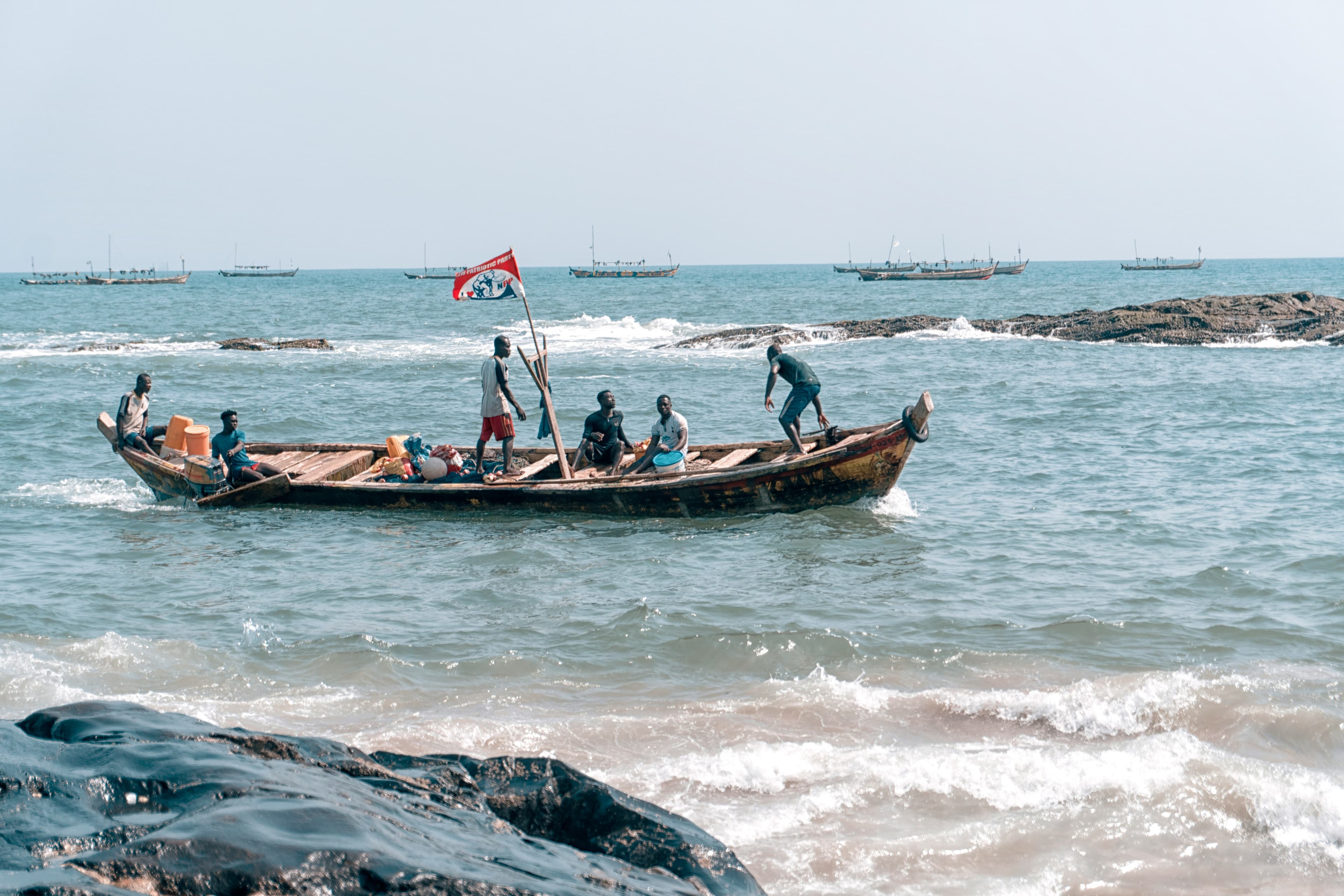
Elmina’s fishing harbour naturally draws attention with its colourful boats, movement and busy waterfront. It is an excellent place to understand the importance of the maritime economy to local life, provided tourist observation does not become intrusion into a workplace.
Landing catches, handling goods, repairing equipment and selling fish all involve professional constraints that visitors must respect. An accompanied visit can explain the main features of these activities without obstructing routes or slowing people down. Photography requires particular care here.
A scene may seem striking or representative of Ghana, but that does not automatically entitle anyone to photograph people at close range, especially children, without their consent. Travellers should ask permission, accept refusals and favour images that respect everyone’s dignity.
This approach to encounters does not diminish the pleasure of discovering the harbour; it gives the experience greater meaning. It encourages visitors to see maritime activities as a combination of skills, effort and economic relationships rather than an exotic backdrop. The contrast between the castle and the harbour can also prompt reflection on the continuity of local life across centuries.
Without equating present-day activities with past trade, visitors can better understand how the sea remains a resource, a horizon and a defining element of Elmina’s identity.
Fort St Jago and other heritage perspectives
Fort St Jago, also known as Fort Coenraadsburg, stands on elevated ground near St George’s Castle and forms part of the UNESCO-listed property. The relationship between the two fortifications helps explain coastal surveillance and defence strategies, as well as rivalries between trading powers. A UNESCO document notes that a Portuguese church preceded some developments at the St Jago site, highlighting the succession of religious and military uses. A complementary visit is worth considering when access and time allow; it should not be advertised as automatically included in an excursion. [1] [3]
Heritage Connecting Ghana to the World
Elmina Castle and Cape Coast Castle: Complementary perspectives
Cape Coast Castle and Elmina Castle belong to the same UNESCO-listed property, but their histories and layouts differ. Elmina helps explain the Portuguese establishment of 1482 and later changes under Dutch administration; Cape Coast offers other perspectives on trading networks and the memory of the slave trade.
A combined excursion can be worthwhile for visitors with sufficient time, provided the pace allows questions, quiet reflection if desired, and more than hurried photographs at two places of remembrance. Their complementary value lies as much in the differences as in their shared themes.
The African diaspora and journeys of remembrance
For many travellers of African diaspora heritage, visiting Ghana’s former forts and castles forms part of a search for historical understanding, connections and sometimes quiet remembrance. This dimension gives Elmina a significance far beyond that of a tourist monument.
Family histories of the Black Atlantic, the legacies of slavery and the experiences of dispersed communities may find a symbolic meeting point here. Nevertheless, not every visit should be described as a literal return to one’s origins.
The castle alone cannot identify individual ancestors’ routes or reconstruct genealogies; such research requires specific, often fragmentary sources. Its value lies instead in the opportunity to approach a collective history and reflect on the consequences of forced displacement.
Emotional responses vary considerably: some visitors need to talk, others prefer silence, and others focus on historical facts. Responsible interpretation recognises this diversity and refrains from turning individual sensitivities into a sales argument.
From this perspective, Kiblistours can support travellers through flexible organisation, a respectful pace and explanations that leave room for questions. Remembrance tourism is not intended to impose a conclusion; it can help create the conditions for informed dialogue about the past, dignity, resistance and the transmission of knowledge between generations.
What younger generations can learn from a visit
Elmina Castle is a particularly important educational resource for schoolchildren, students and travellers seeking a deeper understanding of African and world history. The site connects concepts sometimes studied abstractly with tangible spaces: maritime trade, domination, systems of slavery, colonial transformations and contemporary heritage.
An educational visit should not, however, be limited to teaching a chronology. It can encourage participants to examine how historical knowledge is produced, distinguish facts from interpretations and consider the consequences of institutionalised violence.
Guides and teachers may, for example, invite young people to compare the functions of different parts of the castle, discuss the role of archives and understand why narratives of remembrance vary between groups and periods. These discussions must remain appropriate to participants’ maturity, as some spaces and subjects may provoke strong reactions.
The most productive approach combines accuracy, sensitivity and freedom to ask questions. It does not seek to induce a particular emotion, but to provide the tools needed to understand the past and reflect on the present. By incorporating Elmina into carefully prepared cultural and educational programmes, Kiblistours can contribute to tourism that develops understanding while enriching the travel experience.
Remembrance then becomes a living field of learning, in which visiting a monument opens the way to reading, discussion and research that continue long after returning home.
Preparing for a Respectful Cultural Visit
Responsible tourism: Practical principles for the visit
A responsible visit to Elmina Castle begins long before entering the fortress. It involves preparing travellers for the subjects addressed, clearly explaining the excursion’s itinerary and checking access conditions. On site, the management’s instructions should take priority over the pursuit of a photograph or an unusual experience.
Memorial spaces call for a restrained attitude, particularly when other visitors are reflecting quietly or listening to a guide. Photography must comply with local rules, and interactions with residents must be based on their consent. This is especially important in the neighbourhoods and fishing harbour, where professional activities must not be disrupted.
Quality cultural tourism should also draw on local expertise, pay fairly for services actually provided and avoid guaranteeing encounters that depend on people’s availability. Responsibility also extends to historical content. Accounts must be sourced, approximations acknowledged and practical information regularly checked.
By adopting these principles, Kiblistours can develop an experience that benefits travellers while respecting places and communities. Authenticity is not measured by imposed proximity to residents or the pursuit of a dramatic emotional response; it is reflected in the quality of exchanges, the accuracy of interpretation and consistency between stated commitments and observed practices.
Planning the journey from Accra and organising your time
A visit to Elmina Castle can be included in a stay in Ghana, particularly from Accra, but planning must account for distances, traffic and the time needed to appreciate the site properly. An overloaded itinerary risks turning a demanding cultural experience into a succession of transfers, at the expense of understanding and comfort.
It is better to allow reasonable flexibility, check opening hours with site management and confirm transport and guiding services in advance. Depending on the programme, an excursion may focus on Elmina or form part of a longer stay exploring Cape Coast, the coast and other aspects of Ghanaian culture.
The appropriate duration depends on the departure town, season, group expectations and site availability. Travellers should also anticipate weather conditions, hydration needs and possible challenges posed by staircases or narrow spaces within the fortress.
People with reduced mobility should request detailed confirmation of accessibility, as the monument’s age may limit access to some routes. Families with children can prepare by explaining the historical themes in an age-appropriate way.
For Kiblistours, the objective is realistic planning in which safety, quality support and time for discovery matter more than the number of stops listed in a brochure.
What Visitors Often Do Not Know About Elmina Castle
Behind the best-known dates and memorial spaces lie episodes that cast Elmina’s history in a different light. These five facts, drawn from official heritage sources, show that the castle was a place of trade, domination, international movement and successive transformation. They invite visitors to explore the monument with curiosity, without confusing distinct events or diminishing the violence of the transatlantic slave trade.
1. Java Hill recalls a history linking Elmina to Indonesia
In the nineteenth century, soldiers from the Elmina region went to serve in the Dutch colonial army in the East Indies, corresponding mainly to present-day Indonesia. According to a study published in UNESCO’s World Heritage Papers, some returning soldiers settled on a hill in the town that retains the name Java Hill; they also contributed to the spread of batik techniques.
This history, distinct from the transatlantic slave trade, reveals another geography of forced or organised movement within colonial empires. It also provides another reason to consider the town of Elmina itself, rather than its castle alone, as a place of remembrance. Source: UNESCO, World Heritage Papers 13, “World Heritage at Risk in Declining Towns”, Elmina section.
2. Fort St Jago was built to prevent a repeat attack
In 1637, the Dutch placed cannon on the hill overlooking the Portuguese castle and used this position to force its defenders to surrender. After their victory, they recognised the risk posed by this strategic height and built Fort Coenraadsburg, also known as St Jago, there in the 1660s.
Unlike many fortified establishments along the coast, this fort had a primarily military function and contained no commercial warehouses. The site had previously accommodated a small Portuguese chapel. Considering the two monuments together helps explain how terrain, lines of fire and European rivalries shaped Elmina’s landscape. Source: Ghana Museums and Monuments Board, “Fort St.Jago, Elmina (1660s)”.
3. The castle visitors see has not remained unchanged since 1482
The Portuguese foundation of São Jorge da Mina dates to 1482, but the fortress underwent major changes over the centuries. The Ghana Museums and Monuments Board refers, in particular, to rebuilding under Dutch administration between 1770 and 1775. Today’s silhouette should therefore not be interpreted as an intact reproduction of the first Portuguese establishment. Visitors benefit from distinguishing the monument’s foundation date from the actual age of its different parts, and asking guides which features belong to which periods. This architectural reading qualifies the idea of a building frozen in time. Source: Ghana Museums and Monuments Board, “St. George’s Castle (Elmina Castle), Elmina (1482)”.
4. The castle served other purposes after its trading-post era
The castle was transferred to the British on 6 April 1872, but its history does not end there. The Ghana Museums and Monuments Board states that, in later periods, it served as a training centre for police recruits and as a secondary school, before taking on its present museum role. These successive uses show how the monument remained part of Ghana’s institutional and social life. They raise a valuable question for a visit: how can the memory of a place’s earlier functions be preserved while giving it a contemporary educational role? Source: Ghana Museums and Monuments Board, “St. George’s Castle (Elmina Castle), Elmina (1482)”.
5. The museum displays much more than objects associated with captivity
The museum within the castle is not limited to objects connected with slavery. The Ghana Museums and Monuments Board describes collections including gold weights, shackles, textiles, stools, ceramics, stone objects, beads and photographs tracing the castle’s development. These pieces place the monument within a broader economic, cultural and material history. They also encourage visitors to distinguish period objects, interpretive documents and museum displays, without assigning an origin or function to an object that its label does not confirm. Source: Ghana Museums and Monuments Board, “St. George’s Castle (Elmina Castle) Museum”.
How to Make the Most of Your Visit to Elmina Castle
A rewarding visit to Elmina depends on the time given to each place rather than the number of places covered. The following route is a realistic editorial suggestion, to be adapted to castle opening hours, traffic, guide availability and access conditions. It is neither a contractual programme nor an account of a visit actually undertaken by Kiblistours.
Before arrival: Preparing for a relaxed visit
Whether departing from Accra, Cape Coast or another town, confirm transport, the meeting point, entry conditions and the language of the accompanying service. Travellers should bring suitable walking shoes and water, and allow enough time to avoid rushing. Opening hours announced by the Ghana Museums and Monuments Board may change and should therefore be reconfirmed directly before travelling. People with reduced mobility or concerns about confined spaces should explain their needs so that possible adjustments to the route can be checked.
On arrival: Understanding the landscape before entering
Begin by taking a few moments to place the castle within its surroundings. Its position near the Atlantic and the Benya River, together with the harbour, played a decisive role in its establishment. Observing the walls and access points helps explain the importance of trade and defence without reducing the site to a sequence of dates. A historical introduction, delivered according to site management arrangements, then provides essential reference points: 1482 for the Portuguese foundation, 1637 for the Dutch conquest, 1872 for the British transfer and 1979 for the heritage property’s UNESCO inscription.
Inside the castle: Following the pace of history
The visit may continue through accessible courtyards, rooms and detention spaces, following authorised guides’ instructions. The contrast between areas of command and the former dungeons helps explain the organisation of power and the violence of the slave trade. Near the Door of No Return, silence and listening can be as meaningful as explanations. Photography must respect site rules and other visitors’ sensitivities; suffering does not need to be staged to appreciate the significance of this heritage. Allow time for questions and avoid treating oral accounts as certainties when historical sources do not corroborate them.
After the historical route: Exploring the museum collections
Where access and the course of the visit allow, the museum collections provide further insight into the gold trade, everyday objects, relationships between African and European actors, and representations of the castle at different times. Gold weights, textiles, photographs and other objects described by museum management extend the explanations received within the architectural spaces. Taking time to read labels and ask questions improves understanding, particularly when travelling as a family or with a school group.
On leaving: Discovering Elmina without disturbing its residents
A walk nearby may offer views of the fishing harbour, streets and aspects of urban heritage, while respecting those who live and work there. Fish landings and commercial activities are not performances organised for visitors; keep your distance when operations require it and ask permission before photographing anyone. A break or a local meal can extend the experience if arranged beforehand. This stage gives proper attention to the contemporary town, which cannot be reduced to its colonial past.
If time allows: Continuing to St Jago or Cape Coast
Travellers interested in military strategies may consider visiting Fort St Jago, on the hill facing the castle; access must be confirmed before including it in the programme. Those with a longer day or a multi-day stay may also consider Cape Coast Castle to compare two distinct historical trajectories. In every case, the aim is to maintain a reasonable pace and leave travellers free to reflect quietly, discuss or simply think. Kiblistours can help design a Standard, Premium or VIP itinerary suited to the group, subject to actual service availability.
Travellers’ Perspectives: Three Illustrative Stories to Imagine a Visit to Elmina
The three scenes below are fictional first-person narratives, created solely to illustrate a possible visit. They are neither customer reviews nor accounts of actual experiences at Elmina with Kiblistours.
A historical discovery that gives meaning to a journey-illustrative story
“I stopped in front of the castle’s pale walls. From a distance, the building seemed peaceful. Then, as I imagined the course of a guided visit, I understood how misleading that first impression could be. In the former detention spaces, I would have needed silence and, above all, precise explanations rather than sensational stories. On leaving, I think I would have looked at the ocean differently.” — Fictional narrative, not attributed to a customer.
Heritage and the town today-illustrative story
“Leaving the fortress, I would have liked to take time to observe the canoes and the fishermen’s movements, without approaching closely enough to interfere with their work. The noise of the harbour, the conversations and the busy streets would have reminded me that Elmina is more than a place of remembrance: it is a town where people live. I would ask before taking any close-up photographs.” — Fictional narrative, not attributed to a customer.
The comfort of a well-organised visit-illustrative story
“For a first visit to Ghana, I would like to know from the outset where to meet the driver, how much time to spend at the castle and what is included. A clear programme would leave me free to listen to the guide and ask questions. I would prefer an extra break to another stop added in a hurry.” — Fictional narrative, not attributed to a customer.
Evidence from Travellers: What Kiblistours’ Public Reviews Actually Support
Trust in a travel agency also develops through publicly documented experiences. On its official reviews page, Kiblistours presents several accounts attributed to travellers who discuss excursion organisation, the quality of support and guides’ explanations, particularly during visits in Benin. These testimonials help assess the agency’s general approach, but do not provide evidence of visits undertaken at Elmina. It would therefore be incorrect to present them as reviews of the castle or of a particular Ghanaian itinerary. This deliberately explicit distinction protects readers against excessive generalisation and makes the commercial presentation more credible.
For example, the public review attributed to Richard Guisso highlights the team’s professionalism and ability to accompany a bilingual group; the one attributed to Peter Kwok mentions well-received organisation during a cultural experience in Benin. These comments reflect individual perceptions published on the Kiblistours website, rather than an independent evaluation or feedback on Elmina. Travellers wishing to check these testimonials can consult the official reviews page directly, while the precise conditions of an excursion in Ghana must be separately confirmed before booking.
Choosing Your Kiblistours Package: Three Distinct Experiences
Standard-The essential keys to Elmina’s history
Understand the essentials of Elmina Castle without rushing. Suggested itinerary: round-trip transport from Accra at the agreed meeting point, an air-conditioned vehicle, coordination by a Kiblistours tour escort, reception at the site, admission and a historical visit with an authorised guide, subject to confirmation by site management. Time is allowed for the courtyards, former dungeons, Door of No Return and questions. Drinking water and logistical assistance are provided during the excursion. Meals, accommodation and extensions are not included unless expressly stated in the quotation. The quotation will specify duration, timings, guiding language, vehicle type and number of participants.
Premium-Explore the history and discover the town
Combine remembrance, living heritage and comfort. The Premium package builds on the Standard itinerary and offers, subject to availability, a smaller group, more time for discussion with the guide, a higher-category air-conditioned vehicle, an accompanied walk around the castle and a respectful introduction to the fishing harbour. A lunch stop at a local restaurant and free time to appreciate the town complete the suggested programme. A Kiblistours tour guide coordinates with the monument’s local guide. Any specific cultural encounter, along with the meals and admission fees actually included, is confirmed in the quotation before booking.
VIP-A private exploration at your own pace
Experience Elmina at your own pace with an entirely personalised programme. Private departure from Accra or another agreed location, an air-conditioned vehicle with a dedicated driver, a Kiblistours tour guide and a castle visit with an authorised guide in accordance with site rules. Timings and breaks are adjusted to the group’s interests; additional time may be possible for remembrance, permitted photography and discussion. On request and after access is confirmed, the programme may include Fort St Jago, Cape Coast Castle, a selected lunch or an overnight stay in Elmina. Transport and accompanying services are private, but the castle is not reserved exclusively for the group. Options, accommodation categories, meals, admission fees and any supplements are detailed in a personalised proposal.
Plan your Elmina experience with Kiblistours: choose Standard, Premium or VIP and request a detailed programme at [email protected] or through https://kiblistours.com/fr/tours. Services, availability and prices are confirmed before booking.
Frequently Asked Questions About Elmina Castle-Consolidated FAQ
Why is Elmina Castle famous?
Built by the Portuguese in 1482, Elmina Castle bears witness to the gold trade, colonial rivalries and the transatlantic slave trade. It belongs to a group of Ghanaian forts and castles inscribed on the UNESCO World Heritage List in 1979.
Is Elmina Castle a World Heritage Site?
Yes. Since 1979, it has formed part of the UNESCO property “Forts and Castles, Volta, Greater Accra, Central and Western Regions”. The inscription covers several monuments, rather than Elmina alone.
Can you visit the dungeons and the Door of No Return?
Heritage visits generally include the former dungeons and the Door of No Return, subject to access and conservation conditions set by site management. The route should be approached respectfully and can be emotionally demanding.
How much time should you allow?
Allow enough time for the guided visit, questions and any quiet reflection. Exploring the harbour or Cape Coast requires additional time; the precise duration is stated in the confirmed programme.
Can you combine Elmina and Cape Coast?
Yes, provided there is enough time to visit both castles without rushing. The choice depends on your departure point and traffic conditions.
Can families or school groups visit?
A family or educational visit is possible, but adults should prepare children for the themes of captivity and slavery. For school groups, booking and supervision arrangements must be confirmed with site management. [5]
Can you book a French-speaking guide with Kiblistours?
Kiblistours can explore French-speaking support, depending on availability. The language of the guided visit inside the castle and access arrangements must be checked before confirmation, as external accompanying services and institutional interpretation may be provided by different organisations.
What are the opening hours and admission fees?
Opening hours and admission fees may change. They must be confirmed with site management before the final booking.
Do the testimonials published by Kiblistours concern Elmina?
The reviews cited in this article concern other cultural experiences published on the Kiblistours website, mainly in Benin. They are not presented as feedback from visitors to Elmina Castle.
An Encounter with History, Remembrance and Contemporary Ghana
Elmina Castle is much more than a remarkable fortress on the Atlantic coast. Its architecture, collections and memorial spaces invite visitors to understand trade, relations of domination and the transatlantic slave trade, while also discovering today’s vibrant town. To plan a thoughtful visit tailored to your interests, visit https://kiblistours.com/fr/tours or email [email protected]. Kiblistours — Experience authentic Africa!