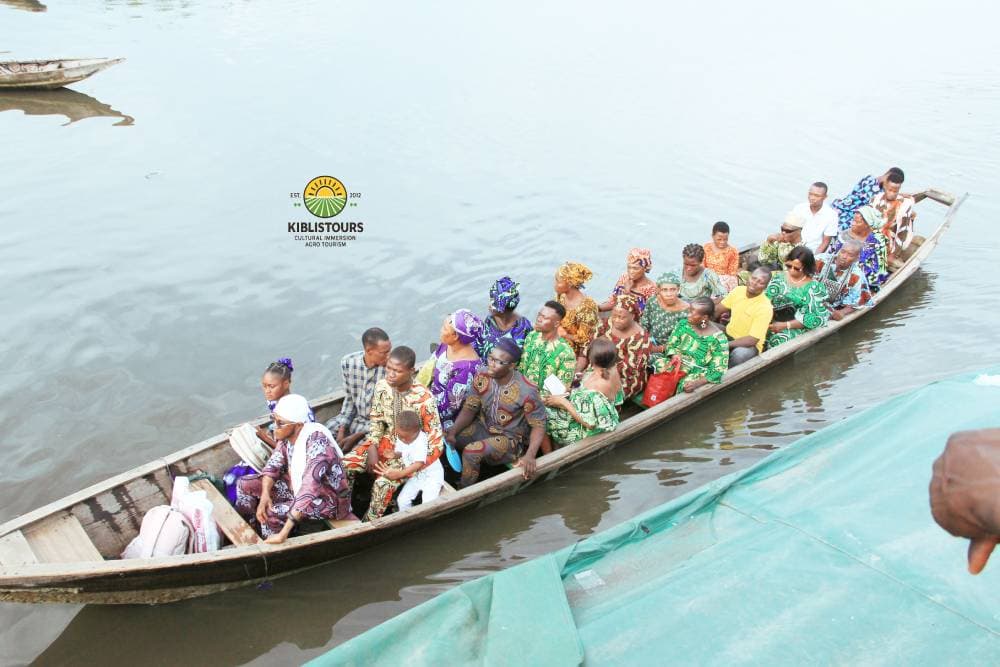
There is a very special moment when you set off for Ganvié.
At first, you are still surrounded by the bustle of dry land: motorcycles pass by, conversations overlap, while travellers check their phones, adjust their bags or already prepare their cameras.
Then the canoe moves away. Within a few minutes, the noise fades, the horizon opens up and, gradually, something appears in the middle of the water: one house, then another, a canoe loaded with goods, a fisherman, a woman moving across the lake and children making their way to another home.
You then realise that you are not simply crossing Lake Nokoué: you are entering a territory where water shapes an essential part of everyday life.
Welcome to Ganvié, one of Benin’s most unique destinations.
It is often nicknamed the “Venice of Africa.” But Ganvié deserves more than a comparison, because behind the photographs of houses on stilts lies a much deeper story: that of a community, a remarkable adaptation to its environment and a way of life shaped over generations.
With Kiblistours, our ambition is therefore not simply to show you Ganvié. We want to help you understand what you are looking at.
They Thought They Were Coming to See a Village on the Water…
When discovering Ganvié for the first time, you generally arrive with a few images already in mind: houses on stilts, canoes, the floating market and the vastness of the lake. You are already thinking about the photographs you will take.
Then, sometimes, a small moment completely changes the way you see things.
Imagine your canoe crossing paths with a woman carrying goods. You find the scene beautiful, and your first instinct may be to take out your phone. But your guide explains that this boat is not there for visitors: it is her working tool.
A few moments later, another canoe passes, then another. You begin to understand that what you initially saw as a tourist attraction is actually a place for living, travelling, working and trading.
From that moment on, Ganvié is no longer simply spectacular: it becomes human.
And that is often where the real visit begins.
The History of Ganvié: When Water Became a Refuge
To understand Ganvié, its history must be placed within the much broader history of West Africa and the slave trade.
Historical accounts devoted to the settlement and traditions passed down locally associate the establishment of the Tofinu people in this lake environment with a search for protection from slave raids affecting the region at the time.
This history is sometimes told in an overly simplified way in tourist brochures. The historical reality deserves greater caution.
Ganvié was not built in a day. Its development is the result of a complex community history, gradually shaped by the environment, fishing, trade and the generations that have succeeded one another on the lake.
When you look at a house on stilts today, you are therefore not simply looking at unusual architecture: you are also discovering the result of a long process of human adaptation to an aquatic territory.
Water is not simply the backdrop of Ganvié. It is part of its history, its economy and its identity.
And that nuance completely changes the visit.
“Venice of Africa”: A Nickname That Does Not Tell the Whole Story
Ganvié is often presented as the “Venice of Africa”. The nickname is appealing because it immediately evokes a town where water and boats play an essential role.
But if you come to Ganvié simply looking for an African Venice, you may miss what truly makes this place exceptional.
Ganvié does not need to resemble Venice to be fascinating: it has its own history, architecture, traditions, challenges and, above all, its own relationship with water.
We therefore prefer to see this nickname as an invitation: it captures your attention, and then Ganvié tells its own story.
When the Canoe Becomes a Road
In many cities, when you want to get around, you take a car, taxi, bus or motorcycle. In Ganvié, an essential part of everyday transportation takes place on the water.
The canoe therefore becomes much more than a picturesque boat: it is simultaneously a means of transport, a working tool and sometimes a commercial space. For travellers, it also becomes a remarkable observation point.
Imagine yourself sitting in your canoe as the pace slows. Another boat passes a few metres away, then another. After a while, you almost stop noticing the absence of cars, and your eyes adapt to the landscape.
What seemed extraordinary twenty minutes earlier gradually begins to form a coherent system.
This is one of the most interesting moments of a visit to Ganvié: amazement gradually gives way to understanding.
To continue discovering the country in this way, read Authentic Travel in Benin: Culture, Vodun, Nature and Encounters with Kiblistours.
Ganvié’s Floating Market: When Commerce Takes to the Canoe
Ganvié’s floating market is one of the most iconic scenes in the lake settlement.
Here, commercial activity also adapts to the environment. Women traders move around in canoes carrying fish, food products, everyday items and other goods.
For visitors, the scene is extremely photogenic, but resist the temptation for a few moments to see everything only through a screen. Instead, observe the gestures, the way the boats approach one another, the exchanges, the balance and the conversations.
Imagine a trader approaching you. You look at a product without really knowing what it is; your guide asks her a question, she answers and a short conversation begins. Perhaps she explains how the product is used or prepared. You smile, she smiles too, and a few minutes later you continue on your way.
Nothing spectacular has happened. And yet, you may just have experienced one of the moments you will remember most, because travel often becomes memorable precisely when it stops being a spectacle.
The Acadja: When a Few Branches Tell an Entire Story
In some parts of Lake Nokoué, travellers may notice clusters of branches planted in the water. Without an explanation, it is easy to pass by without paying much attention.
Yet they tell an important part of the story of fishing in Benin’s lagoons: these are known as acadjas.
FAO documentation describes acadjas as brush-park fisheries developed in Benin. They are traditionally made from branches placed in relatively calm and shallow waters, creating areas that encourage the concentration of fish and the development of the organisms on which they feed.
Scientific studies devoted to Lake Nokoué also show that acadjas are an important system for understanding local fishing practices, while also raising questions of management and ecological balance when their density becomes significant.
That is why this part of the visit is particularly interesting.
Your canoe passes a few branches. Nothing seems extraordinary, then your guide explains their purpose and, suddenly, the landscape changes.
You no longer see a few branches planted in the water: you discover know-how, an economic activity, a fishing technique and an environmental issue all in the same place.
Without explanation, you see branches. With context, you begin to read the lake.
Houses on Stilts: More Than a Postcard
The homes of Ganvié are obviously among the first things you notice. At times, they seem to float above the lake.
Yet they should not be viewed simply as architectural curiosities.
Above all, they are places where people live: families live there, children grow up there, meals are prepared there and family conversations take place there. Ordinary days begin and end behind the façades that visitors photograph.
This reality implies one essential rule: respect for residents’ privacy.
A picturesque house for a traveller is still someone’s home. A person in a canoe is not automatically a photographic subject, and a child is not an attraction.
Asking permission before taking certain photographs does not diminish the experience. On the contrary, this small gesture reminds you that you are not in a setting: you are a guest discovering an inhabited territory.
To explore this human dimension further, discover Ganvié, the Venice of Africa: A Journey That Transforms.
A Small Lesson Ganvié Can Teach Travellers
Sometimes a traveller is constantly looking for “the best photo”: the best house, the best canoe, the best angle or the best sunset.
Then, for a few seconds, they put their phone away.
It is precisely at that moment that a canoe glides slowly past. You hear a conversation in the distance, the sun reflects on the water and a light breeze comes across the lake. No one speaks.
Almost nothing is happening, and yet everything is there.
Ganvié has this ability to remind us of something very simple: we do not travel only to bring back images, but also to experience moments that no one else will ever see in exactly the same way.
Ganvié Through the Eyes of a Child
Now imagine that you are travelling with your child.
At first, your child looks at the houses, then asks a very simple question:
“But where are the roads?”
You smile, and the guide points to the canoes.
A few minutes later, more questions follow: “And how do they go to the market? How do they go to school?”
What was initially an excursion suddenly becomes a remarkable lesson in geography, history and human adaptation.
That is also the power of Ganvié: the village forces us to question certain things we take for granted.
Does a street necessarily have to be made of asphalt? Does a market necessarily have to be inside a building? Does a community have to organise its daily life the way we organise ours?
Ganvié answers these questions without giving a speech. Sometimes, all you have to do is look around.
Between Beauty and Reality: Do Not Turn Ganvié into a Postcard
It would be easy to describe Ganvié as a floating paradise where everything is peaceful and perfect. But that would reduce the community to a tourist image.
A contemporary lake settlement also faces very real issues: the environment, water quality, economic activities, fishing, infrastructure, sanitation and tourism development.
Research on acadjas illustrates this complexity: a traditional technique can have considerable economic and cultural importance while still requiring careful management to preserve the ecological balance of the lake.
Truly responsible tourism should therefore not hide these realities. It should help travellers understand that authenticity does not mean perfection.
Authenticity means encountering a territory as it truly exists: with its beauty, history, inhabitants, transformations and challenges.
At Kiblistours, this distinction matters. We do not want to create an imaginary Ganvié simply to satisfy travellers: we want to help you encounter the living Ganvié.
Ganvié and Responsible Tourism: Visiting Without Disturbing
The tourism success of a destination can create economic opportunities, but it also creates responsibility: Ganvié is not an amusement park; it is a community.
Respectful tourism requires a few simple gestures:
ask before directly photographing certain people;
follow the guidance of local guides and residents;
avoid intrusive behaviour;
never throw rubbish into the lake;
choose local products and services whenever possible;
respect private spaces;
listen to residents rather than projecting our own idea of “authenticity” onto them.
These gestures may seem modest, but together they profoundly change the way we travel.
Responsible tourism rarely begins with grand declarations. It often begins with the way we look at and treat the people we meet.
This philosophy is part of a broader vision of authentic Benin, combining culture, Vodoun, nature and encounters.
Why Is Ganvié a Must-See on a Trip to Benin?
Ganvié brings several dimensions together in a single experience:
history, with the formation and development of the lake community;
culture, with knowledge and practices shaped by the relationship with water;
encounters, with residents and local stakeholders;
nature, with the vastness of Lake Nokoué and its ecosystem;
photography, with remarkable landscapes and scenes of everyday life, provided that people are respected;
reflection, because Ganvié challenges the way we think about housing, transportation, commerce and adaptation to the environment.
For travellers searching for the best “Things to do in Benin,” Ganvié deserves much more than a quick stop: it is a genuine cultural experience.
To go further: discover authentic Benin with Kiblistours.
You can also explore the Travel in Benin – Tours & Destinations page to discover how Ganvié can be incorporated into a more comprehensive itinerary.
Visiting Ganvié from Cotonou: A Few Kilometres, Another World
One of Ganvié’s great advantages is its proximity to the Cotonou metropolitan area.
This makes it possible to include it in a day trip from Cotonou or in a more comprehensive tour of southern Benin. To extend your journey, you can also explore Kiblistours destinations.
And the contrast is striking.
You can begin your day surrounded by urban activity and, a short while later, find yourself on the water. The motorcycles have disappeared, buildings have given way to the lake and the pace changes.
This transition is itself part of the experience. It also highlights the extraordinary diversity that a journey through Benin can offer over relatively short distances.
Discover Ganvié with Kiblistours: See More Slowly, Understand More Deeply
A visit to Ganvié can be very simple: get into a canoe, take a few photographs, then return. But we believe it can offer much more.
With Kiblistours, we aim to create an experience in which professional guidance brings context to the landscape.
Depending on the package selected, the experience may include:
professional assistance;
the services of a local guide who knows the area;
a contextualised discovery of Ganvié’s history;
explanations about everyday life and activities on the lake;
a respectful approach to local residents;
a pace that allows you to observe rather than simply pass through;
services adapted to the Standard, Premium or VIP level selected.
The combined perspectives of the accompanying guide and the local guide can be particularly valuable: one structures your experience, while the other brings intimate knowledge of the territory.
And sometimes, the most interesting sentence of the entire day does not come from a book. It simply comes from someone saying:
“Take a good look at this.”
You look. And suddenly you understand something that had been right in front of you for several minutes.
Standard, Premium or VIP: Choose How You Want to Experience Ganvié
Because not all travellers are looking for the same experience, Kiblistours offers three levels of discovery. Services may vary according to availability, local conditions and booking arrangements.
To view the experience and choose your package, discover Ganvié – Authenticity Along the Water with Kiblistours.
Ganvié Standard – The Essentials of the Lake Settlement
An essential and accessible discovery of the lake settlement for travellers who want to encounter Ganvié, understand its history and observe everyday life without turning the experience into a simple photo tour.
The package includes, in particular:
dual guiding;
canoe ride;
handicraft workshop using water hyacinth;
discovery of Ganvié’s history and traditions;
introduction to traditional paddling;
local snack;
local tourism insurance.
Ganvié Premium – Go Deeper into Life on the Lake
An enriched cultural immersion designed to give you more time to encounter the territory, discover its know-how and extend the experience beyond a conventional boat ride.
The package includes, in particular:
round-trip transportation from Cotonou;
dual professional assistance;
guided navigation;
participatory handicraft workshop;
introduction to paddling;
discovery of Sô-Avâ and Sô-Tchanhoué;
lunch on stilts;
local tasting;
souvenir photo and video package;
snack;
local tourism insurance.
Ganvié VIP – The Lake, Just for You
A private and personalised experience for travellers who want to discover Ganvié at their own pace, with greater comfort, availability and personalisation.
The package includes, in particular:
driver and premium vehicle;
dedicated personal guide;
expert local guide;
private canoe;
handicraft workshop;
introduction to traditional fishing;
discovery of surrounding lake settlements;
lunch in a house on stilts;
photo and video package;
exclusive access subject to agreements and availability;
private traditional dance upon request;
contribution to a local community initiative.
Whichever package you choose, our principle remains the same: to respect Ganvié as much as we want you to love it.
Discover more Kiblistours destinations and experiences to include Ganvié in a broader itinerary through Benin.
Practical Tips for Visiting Ganvié
To make the most of your excursion, choose lightweight and comfortable clothing. Sun protection, a hat or cap can be useful during the boat ride, and it is advisable to protect your phone or camera from splashes.
Keep water with you according to the arrangements of your excursion, and always ask before directly photographing local residents.
Above all, do not spend your entire visit behind a screen. Take photographs, of course, but also give yourself a few minutes without a camera.
Ganvié deserves to be preserved somewhere other than your phone’s memory.
FAQ: Everything You Need to Know Before Visiting Ganvié
1. Where Is Ganvié Located?
Ganvié is located in southern Benin, on Lake Nokoué, in the municipality of Sô-Ava, near the Cotonou metropolitan area.
To discover the destination and available experiences, visit Ganvié – Authenticity Along the Water.
2. Why Is Ganvié Called the “Venice of Africa”?
This tourism nickname refers to the importance of water and boats in the organisation of the settlement. However, Ganvié has its own history and identity, which deserve to be discovered beyond this comparison.
To learn more, discover Ganvié, the Venice of Africa: A Journey That Transforms.
3. How Do You Visit Ganvié?
The visit mainly takes place by boat, allowing you to observe the lake environment and different aspects of everyday life.
4. What Is an Acadja?
An acadja is a brush-park fishing technique well documented in Benin’s lagoons. Branches installed in shallow water create structures and refuges that support various organisms and help concentrate fish.
5. Can You Visit Ganvié from Cotonou?
Yes. Ganvié can be included in a day trip from Cotonou or in a broader tour of southern Benin.
6. Can You Take Photographs in Ganvié?
Yes, in many situations, but directly photographing people or certain spaces requires respect and discretion. Ask permission whenever appropriate and always follow your guide’s instructions.
7. Is Ganvié Suitable for Families?
The experience can be particularly interesting for families because of its historical, cultural and environmental dimensions. Navigation arrangements should naturally be adapted to the participants.
8. How Much Time Should You Allow to Discover Ganvié?
The duration depends on the package and programme selected. Ganvié can be included in an excursion or form part of a more comprehensive experience depending on the level of immersion you are looking for.
You can explore Kiblistours tours to discover the different itinerary options.
9. What Is the Best Time to Visit Ganvié?
Ganvié can be visited at different times of the year. As weather and lake conditions can vary, it is best to check the conditions corresponding to your planned dates before the excursion.
The Moment When You May Finally Understand Ganvié
At the end of the excursion, the canoe gradually begins its journey back towards dry land. You look behind you: the houses grow smaller, the boats move farther away and the sounds of the city will soon return.
You look through the photographs you took during the day. There are probably many of them, yet your best memory may not be on your phone.
It may be the laughter of a trader, an explanation from your guide, a fisherman glimpsed in the distance, a question asked by your child or a few seconds of silence in the middle of the lake.
Or simply that precise moment when you understood that the water you came to photograph was, for others, a territory, a road, a workplace and a home.
That is when Ganvié stops being an excursion.
It becomes an encounter.
Message Kiblistours Now on WhatsApp
Experience Ganvié with Kiblistours – Authenticity Along the Water