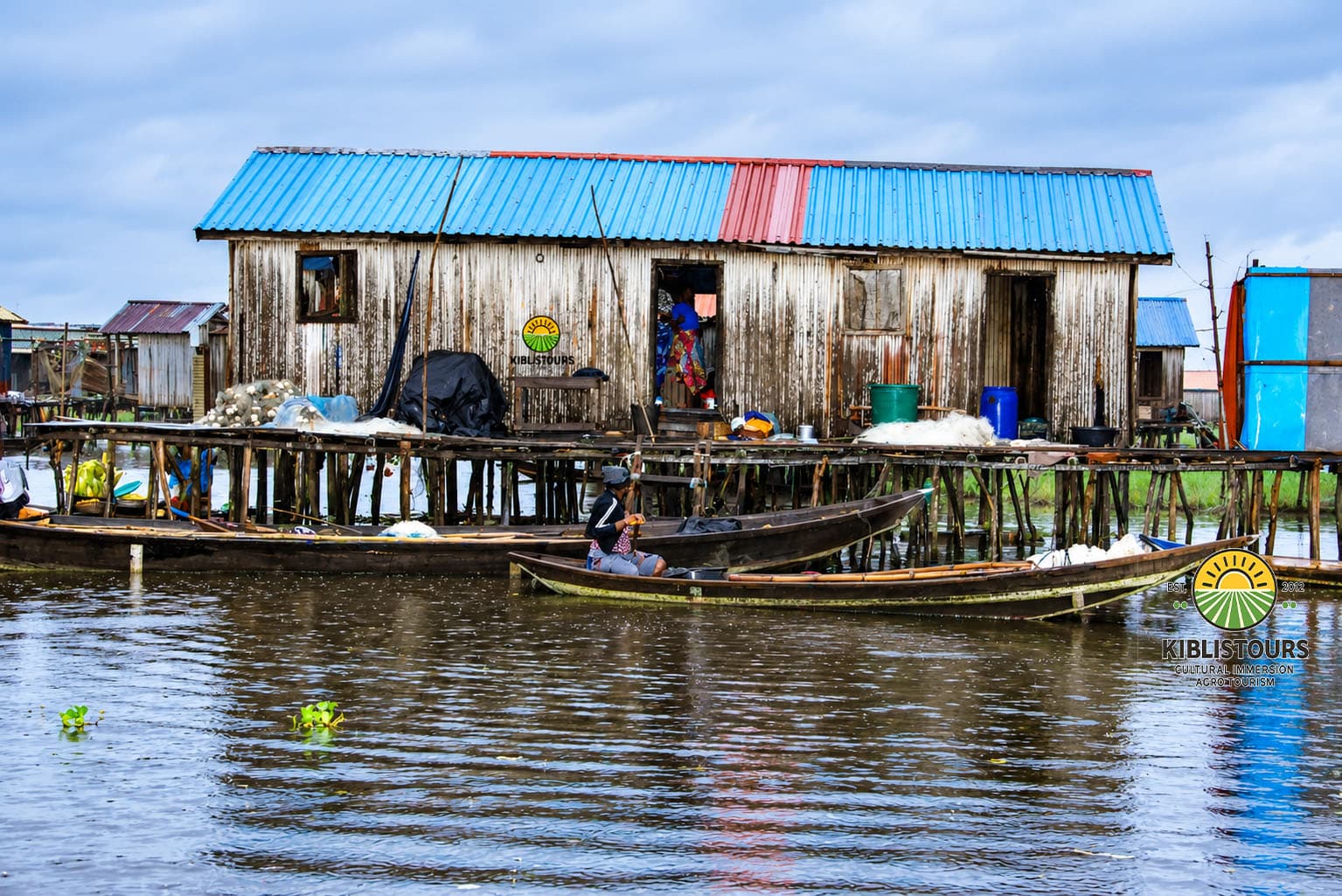
There is a very special moment when you set out for Ganvié.
At first, you are still surrounded by the bustle of life on dry land. Motorbikes pass by, conversations overlap, some travellers check their phones while others adjust their bags or prepare their cameras. Then the pirogue gradually leaves the landing stage and, almost without you noticing, the landscape begins to change.
Within minutes, the noise fades and the horizon opens up. One house appears in the middle of the water, then another. You pass a pirogue loaded with goods, a fisherman busy at work, a woman transporting products for sale, and residents making their way to another part of the town.
It is often at this moment that you realise you are not simply crossing Lake Nokoué. You are entering a place where water shapes an essential part of everyday life.
Welcome to Ganvié, one of the most distinctive destinations in Benin.
It is often nicknamed the “Venice of Africa”. Yet Ganvié deserves far more than a comparison with a European city. Behind the spectacular images of stilt houses and pirogues lies a much deeper story: that of a community, a remarkable adaptation to the environment, and a way of life shaped over generations.
At Kiblistours, our ambition is therefore not simply to show you Ganvié, but to give you the keys to understanding its history, customs and everyday reality.
They thought they were coming to see a village on the water
When discovering Ganvié for the first time, you generally arrive with a few images already in mind: stilt houses, pirogues, women selling goods on the water and the vast expanse of the lake.
Naturally, you think about the photographs you will take home. Then, sometimes, a small detail completely changes your perspective.
Your pirogue passes a woman transporting goods. The scene is beautiful, and your first instinct may be to take out your phone. Your guide then explains that this boat is both a means of transport and a place of work.
Another pirogue passes, then another. Gradually, what initially seemed like a tourist attraction reveals itself for what it truly is: a space for living, travelling, working and exchanging.
Ganvié is no longer merely spectacular. It becomes profoundly human, and this is often where the real visit begins.
The history of Ganvié: when water became a refuge
To understand Ganvié, its history must be placed within the much broader history of West Africa and the upheavals caused by the slave trade.
Historical accounts and locally transmitted traditions associate the settlement of the Tofinnu people in this lakeside environment with their search for protection from slave raids affecting the region.
This history, however, deserves to be told with care. A community this old and complex cannot be summarised in a few lines or reduced to a single explanation.
Ganvié has been built and transformed over time through relationships between its people, the lakeside environment, fishing, trade, local knowledge and successive generations.
When you look at a stilt house today, you are therefore not simply looking at an unusual form of architecture. You are also witnessing the result of a long process of human adaptation to an aquatic environment.
Water is not simply the backdrop to Ganvié: it is part of its history, economy, transportation, social organisation and identity.
Ganvié and UNESCO: an important clarification
Ganvié is sometimes incorrectly presented as a UNESCO World Heritage Site. It is not.
The Lakeside Site of Ganvié historically appeared on an earlier Tentative List for Benin, notably in UNESCO documentation from 1998. However, it no longer appears among the properties on Benin’s current Tentative List.
This distinction is important. Promoting Ganvié does not require attributing an institutional status to it that it does not currently hold: its cultural, historical and tourism significance speaks for itself.
Official source: UNESCO World Heritage Centre – Benin
“Venice of Africa”: a nickname that does not tell the whole story
The nickname “Venice of Africa” is appealing. It immediately evokes a town where water and boats play a major role.
But if you come simply looking for an African version of Venice, you risk missing precisely what makes Ganvié exceptional.
Ganvié has its own history, traditions, forms of housing, economic activities, challenges and, above all, its own relationship with water.
The comparison may capture your attention. After that, Ganvié should be allowed to tell its own story.
Understanding everyday life on Lake Nokoué
When the pirogue becomes a road
In most cities, people travel by car, motorbike, taxi or bus. In Ganvié, an essential part of mobility takes place on the water.
The pirogue therefore becomes far more than a picturesque boat. It is used for transportation, fishing, trade and various activities of everyday life.
For travellers, it also provides a remarkable observation point. Sitting in your boat, you watch other pirogues pass as your eyes gradually adjust to the landscape. What seemed extraordinary only a few minutes earlier begins to form a coherent whole.
You then understand that water plays a role here comparable to that of streets, public squares and certain commercial routes elsewhere.
This is one of the most interesting moments of the experience: when surprise gradually gives way to understanding.
Trade on the water: taking time to observe
Among the images that leave a lasting impression on visitors are women travelling by pirogue with fish, food products and various everyday items.
These scenes are extremely photogenic. But for a few minutes, try not to experience Ganvié only through your screen.
Observe the gestures, the movements of the boats, the exchange of goods and the conversations.
A trader may approach your pirogue. You notice a product without knowing exactly what it is. Your guide asks a question, the trader explains how it is used, a few words are exchanged, and everyone continues on their way.
Apparently, nothing extraordinary has happened. Yet this brief encounter may become one of the most human memories of your excursion, because travel often becomes memorable when it stops being merely a spectacle and becomes a relationship.
The acadja: when a few branches reveal an entire ecosystem
In certain parts of Lake Nokoué, you will notice clusters of branches installed in the water. Without an explanation, it would be easy to pass them without understanding their importance.
These are known as acadjas.
This traditional branch-based fishing system has a long history and is documented in Benin. The branches create an environment that supports the development of organisms on which certain fish feed, thereby helping to concentrate fish.
The FAO has documented the importance of acadjas in the fishing systems of Lake Nokoué and Benin’s lagoons for several decades.
These installations tell several stories at once: the story of traditional knowledge, an economic activity, a particular relationship between communities and their environment, but also the challenges associated with the sustainable management of lake resources.
This part of the visit perfectly illustrates the difference that good guidance can make. Without an explanation, you see branches in the water; with context, you discover a fishing technique, an economic activity, knowledge passed down through generations and an environmental issue.
You are no longer simply looking at the lake: you are beginning to read it.
Documentary source: Food and Agriculture Organization of the United Nations – FAO
Stilt houses: far more than a postcard
The homes of Ganvié are naturally among the first things visitors notice. Some seem almost to float above the lake, creating a particularly striking landscape.
Yet they should not be regarded simply as architectural curiosities. Above all, they are homes.
Families live there, children grow up there, meals are prepared there, and perfectly ordinary days begin and end behind façades that visitors find extraordinary.
This reality requires one simple rule: respect the privacy of residents.
A picturesque house for a traveller is still someone’s home. A person in a pirogue is not automatically a photographic subject, and a child is never a tourist attraction.
Asking permission before directly photographing someone does not diminish your experience. On the contrary, this gesture allows you to discover the town without forgetting the people who live there every day.
Ganvié through the eyes of a child
Ganvié can also become a wonderful discovery experience for families.
Imagine a child looking carefully at the houses before asking:
“But where are the roads?”
The guide points to the pirogues.
Another question follows almost immediately:
“And how do they go to the market?”
Then another:
“And how do the children get around?”
Within minutes, what was meant to be an excursion becomes a living lesson in geography, culture and human adaptation.
Ganvié therefore encourages us to question certain things we consider universal. Does a street necessarily have to be paved? Does a shop always have to be inside a building? Must every community organise transportation and daily activities in the same way?
Ganvié answers in its own way. Sometimes, you simply need to observe.
Between beauty and reality: not turning Ganvié into a postcard
It would be easy to portray Ganvié as a floating paradise where everything is peaceful and perfect. That would be a mistake.
A contemporary lakeside town also faces challenges related to the environment, water quality, sanitation, infrastructure, economic activities, fishing and tourism development.
Acknowledging these realities does not diminish Ganvié’s beauty. On the contrary, it allows us to respect it more deeply.
Authenticity does not mean perfection. It means encountering a place as it truly exists, with its heritage, people, transformations, achievements and challenges.
At Kiblistours, this distinction is essential: our approach is to present Ganvié in all its richness, without idealising it or hiding the realities that are part of its evolution.
Ganvié and responsible tourism: visiting with respect
Tourism can create significant economic opportunities for a destination. But the more visitors a community attracts, the greater everyone’s responsibility becomes.
A few simple behaviours can therefore help you travel more respectfully:
ask permission before directly photographing someone;
respect the recommendations of guides and residents;
avoid intrusive behaviour;
do not throw rubbish into the lake;
respect homes and private spaces;
whenever possible, choose local products and services;
do not treat residents as elements of the scenery;
listen before drawing conclusions about what you observe.
Individually, these gestures may seem modest. Together, they profoundly change the way we travel.
Why is Ganvié a must-see during a trip to Benin?
Ganvié brings together several dimensions of travel in a single experience.
Here, you encounter history through the formation and evolution of a lakeside community; culture through practices and knowledge shaped by the relationship with water; nature through Lake Nokoué and its ecosystem; everyday life through transportation, fishing and trade; but also reflection, because Ganvié challenges our own understanding of housing, mobility and adaptation to the environment.
And, of course, there is photography.
The landscapes are remarkable. Photograph them, but remember that the people who live within these landscapes deserve exactly the same respect you would expect to receive in your own home.
For travellers wondering what to do in Benin, looking for the country’s most memorable cultural experiences or seeking an authentic discovery of Lake Nokoué, Ganvié deserves more than a quick visit.
It deserves time, curiosity and attention.
Visiting Ganvié from Cotonou
One of Ganvié’s great advantages is its proximity to the Cotonou metropolitan area. The lakeside town can therefore easily be included in a Ganvié excursion from Cotonou or in a more comprehensive tour of southern Benin.
The contrast is already part of the experience.
You can begin your day surrounded by urban activity and later find yourself on the lake, surrounded by water, pirogues and lakeside homes. The motorbikes gradually disappear, the urban landscape recedes and your pace changes.
This transition is a reminder of just how many different experiences Benin can offer within relatively short distances.
Discovering Ganvié with Kiblistours: a visit that gives meaning to the landscape
A visit to Ganvié could be very simple: board a boat, travel across the lake, take a few photographs and return to dry land.
We believe it can offer much more.
With Kiblistours, professional guidance helps place the landscapes, activities and encounters within their wider context.
Depending on the experience booked, your discovery may include professional assistance, a guide familiar with the area, a contextual introduction to the history of Ganvié, explanations about everyday life and lakeside activities, a respectful approach to residents, and a pace that gives you genuine time to observe.
The guide’s role is therefore not simply to identify the places you pass, but to reveal their history, function and significance.
Sometimes, a simple invitation is enough:
“Look carefully at this.”
You look again, and something that had been right in front of you for several minutes suddenly takes on a completely different meaning.
Standard, Premium or VIP: choose your Ganvié experience
Not every traveller wants to discover Ganvié in the same way. This is why Kiblistours offers several levels of experience, allowing you to adapt the comfort, guidance and degree of personalisation.
Ganvié Standard
The Standard package focuses on an accessible, organised and guided discovery of the main features of the lakeside town.
This experience is particularly suitable if you are looking for:
an organised discovery of Ganvié;
a boat journey on the lake;
discovery of the main features of the lakeside town;
explanations about its history and everyday life;
guidance to help you understand the essential features of the area.
It is particularly suitable for travellers wishing to enjoy a comprehensive first discovery of Ganvié in good conditions.
Ganvié Premium
The Premium package takes the experience further with greater comfort, more time and deeper immersion.
It is distinguished in particular by the possibility of benefiting from:
an enhanced level of comfort;
more time dedicated to discovery;
more in-depth cultural guidance;
additional encounters or discoveries depending on the package booked;
a snack or meal when included in the selected package.
The aim is no longer simply to travel through Ganvié, but to have more time to explore the different dimensions of the lakeside town.
Ganvié VIP
The VIP package is designed for travellers looking for a more private, personalised and flexible experience.
Depending on the package actually booked and local availability, the experience may include:
private transport;
a driver;
a personal guide;
a private pirogue;
greater flexibility in the pace of the visit;
a more personalised experience;
additional services included in the booked package.
You are no longer simply following a programme: the experience adapts more closely to the way you like to travel.
Whichever package you choose, our principle remains the same: to offer a high-quality discovery while respecting the community, its environment and its way of life.
Practical tips for visiting Ganvié
A few simple precautions can help you make the most of the experience:
wear light and comfortable clothing;
bring sun protection, a hat or cap;
carry water when it is not already included in your package;
protect your phone and camera from splashes;
wear the life jacket provided;
ask permission before directly photographing residents;
follow the instructions of your guide and boat operator;
bring suitable mosquito protection depending on the time and conditions of your visit.
Above all, give yourself a few minutes without your camera.
Some memories deserve to be experienced before they are photographed.
FAQ: everything you need to know before visiting Ganvié
Where is Ganvié located?
Ganvié is located in southern Benin, on Lake Nokoué, in the municipality of Sô-Ava. Its location makes it easy to include in many itineraries through southern Benin.
Why is Ganvié called the “Venice of Africa”?
The nickname refers to the importance of water and boats in the organisation of the town. However, it is a tourism comparison: Ganvié has its own history, culture and identity.
Is Ganvié a UNESCO World Heritage Site?
No. Ganvié is not inscribed on the UNESCO World Heritage List. The Lakeside Site of Ganvié appeared on an earlier Beninese Tentative List, but it no longer appears on Benin’s current Tentative List.
How do you visit Ganvié?
The experience takes place mainly on the water, in a pirogue or another suitable boat, depending on the experience selected and local conditions.
What is an acadja?
An acadja is a traditional branch-based fishing system used particularly in Benin’s lagoons. Branches placed in the water help create an environment favourable to the concentration of fish. This technique is one of the important elements for understanding fishing activities on Lake Nokoué.
Can Ganvié be visited from Cotonou?
Yes. Ganvié can easily be included in an excursion from Cotonou or form part of a broader tour through southern Benin.
Can you take photographs in Ganvié?
Yes, but photographing a landscape and directly photographing a person are not exactly the same thing. Ask permission when necessary and respect your guide’s recommendations as well as residents’ privacy.
Is Ganvié suitable for families?
Yes. The experience can be particularly interesting for families thanks to its cultural, historical and environmental dimensions. Navigation arrangements and the programme should naturally be adapted to the age and needs of participants.
How much time should you allow to visit Ganvié?
The duration depends on the experience selected. An excursion can provide a first introduction, while a more in-depth package offers additional time to observe, interact and explore the area.
What is the best time to visit Ganvié?
Ganvié can be visited at different times of the year. As weather and lake conditions may vary, it is advisable to check the conditions corresponding to your planned date before the excursion.
Should you book in advance?
Advance booking is recommended, particularly if you want a private, Premium or VIP experience, or if your stay in Benin offers little flexibility in terms of dates.
The moment when Ganvié truly makes sense
At the end of the excursion, your boat gradually begins its journey back towards dry land.
You look behind you as the houses become smaller and the pirogues fade into the distance. Soon, the sounds of the city will return.
You may look through the many photographs you took during the day. Yet your best memory may not necessarily be stored on your phone.
It may be the smile of a trader, an explanation from your guide, a fisherman glimpsed in the distance, a question asked by your child, or a few seconds of silence in the middle of the lake.
It may simply be the moment when you realised that the water you came to photograph is, for other people, a route, a workplace and a home.
That is when Ganvié stops being just an excursion.
It becomes an encounter.
Ready to discover Ganvié with Kiblistours?
You could come to Ganvié, take beautiful photographs and leave.
We invite you to go further: discover its history, observe everyday life on the lake, learn more about local knowledge and experience the destination in a way that respects the community welcoming you.
Choose the Standard, Premium or VIP experience that best matches the way you travel, or contact our team to create a personalised experience.
Booking, quotes and information
Request your quote for Ganvié and prepare your experience with the Kiblistours team.
WhatsApp / Phone: +229 01 90 72 17 61
Direct WhatsApp: https://wa.me/2290190721761
Email: [email protected]
Website: https://www.kiblistours.com
Booking: browse the experiences available on the Kiblistours website or contact our team directly to check availability for your dates.
Kiblistours – Experience Authentic Africa
References and sources
Benin Tourism – Ganvié: official presentation of Ganvié, its history, its location on Lake Nokoué, travel by pirogue, fishing and everyday life in the lakeside town. View the official presentation of Ganvié
Benin Ministry of Tourism, Culture and the Arts – Reinventing the lakeside town of Ganvié: presentation of the project dedicated to improving living conditions, lake sanitation, infrastructure and tourism development in Ganvié. View the official project
National Agency for the Promotion of Heritage and Tourism Development (ANPT) – Ganvié Project: institutional information about the history of the lakeside town, its heritage, Lake Nokoué and initiatives to preserve and promote the area. View the ANPT page
UNESCO – World Heritage Centre: Benin: official source for verifying Benin’s World Heritage properties and heritage-related information about the country. View UNESCO’s official page for Benin
UNESCO / African World Heritage Fund – Authenticity and integrity of heritage in the face of development challenges: the case of the lakeside city of Ganvié, Benin: publication discussing Ganvié as a lakeside town, its history as a place of refuge, stilt architecture, travel by pirogue, aquatic environment and contemporary heritage preservation challenges. View the UNESCO document
Convention on Wetlands (Ramsar) – Benin: institutional reference on Benin’s wetlands, including the “Lower Ouémé Valley, Porto-Novo Lagoon, Lake Nokoué” site. View Benin’s profile
Ramsar Sites Information Service – Lower Ouémé Valley, Porto-Novo Lagoon, Lake Nokoué: documentation on this extensive wetland area in southern Benin and its various ecosystems. View the Ramsar documentation
Food and Agriculture Organization of the United Nations (FAO) – Documentation on fishing systems in Benin: documentary source related to acadjas, the traditional branch-based fishing system discussed in this article. View the FAO documentation
Kiblistours – Ganvié: Authenticity Along the Water: presentation of the tourism experience offered by Kiblistours for discovering Ganvié. Discover Ganvié with Kiblistours
Kiblistours – Tours and experiences in Benin: experiences that allow Ganvié to be incorporated into different tours and itineraries offered by Kiblistours. Discover Kiblistours experiences
Kiblistours – Benin: presentation of destinations and experiences offered in Benin. Discover Benin with Kiblistours